
Casinos That Accept Ripple XRP in the UK: What's Real and What's Marketing
 Available in GB
Go looking for a casino that accepts Ripple XRP from a UK address and you find a wall of ranked lists promising instant payouts, zero fees, and a hundred free spins. What almost none of them say out loud, up top, where it matters: not one of those casinos holds a UK Gambling Commission licence. They can’t. That single fact reshapes everything that follows, and it’s the thing worth understanding before you move a single token.
XRP itself is a genuinely good fit for a casino cashier. It settles in three to five seconds, costs a fraction of a penny to send, and doesn’t suffer the congestion spikes that turn a Bitcoin or Ethereum deposit into a guessing game about fees. The technology is not the problem. The problem is where you’re allowed to use it, who stands behind the operator when something goes wrong, and what protections you quietly leave at the door. This guide maps all three.
Can UK-Licensed Casinos Accept Ripple XRP?
No. As of 2026, no casino holding a UK Gambling Commission licence accepts Ripple XRP, Bitcoin, or any other cryptocurrency as a deposit method. This isn’t an oversight or a gap waiting to be filled next quarter. It’s a direct consequence of how the UKGC writes its rules, and the reasoning runs deeper than a simple “crypto bad” headline.
The Gambling Commission regulates every operator serving players in Great Britain under the Gambling Act 2005 and its Licence Conditions and Codes of Practice, usually shortened to the LCCP. Two provisions do the heavy lifting here: the source-of-funds requirements and the anti-money-laundering obligations. A licensed operator has to know where your money came from, verify your identity before you get far, and run affordability checks that are becoming stricter every year. Cryptocurrency, with its pseudonymous wallets and cross-border settlement, sits awkwardly against all of that. You can’t easily document the source of funds for XRP that passed through three wallets and an exchange before landing in a casino cashier, and a UKGC operator that tried would be gambling with its own licence.
There’s movement, but it’s slow and it’s early. The Financial Services and Markets Act 2000 (Cryptoassets) Regulations 2025 brought crypto activity under a formal Financial Conduct Authority framework, which is the kind of groundwork that would need to exist before gambling regulators could even consider the question. Tim Miller, the UKGC’s executive director for research and policy, said publicly that the Commission wants to “start looking at what the potential path forward would be” for crypto as a consumer payment option in regulated British gambling. He called it a “tentative first step.” Read that phrasing carefully: it is a signal that a conversation has started, not a timeline, not a promise, and certainly not permission. The LCCP has not been amended. The register has not changed.
So what does that leave for a UK player holding XRP and wanting to gamble with it? Offshore casinos. Every single operator that genuinely accepts XRP deposits does so from outside the UKGC’s reach, under licences issued in Curaçao, Anjouan, or similar jurisdictions, or in some cases under no meaningful licence at all. These sites are accessible to UK players, they do take your Ripple, and they are not on GamStop. That last point is not a footnote. It’s a trade-off worth a whole section of its own, which it gets below.
A word on the names you already know. Bet365, William Hill, Ladbrokes, Sky Vegas, the household UK brands with their UKGC licences and their GamStop integration, do not accept XRP and will not for the foreseeable future. If a page tells you “William Hill now takes Ripple,” treat it the way you’d treat a text from a prince needing help moving money. Someone is selling you something.
Can I use Ripple (XRP) at UK-licensed online casinos?
No. No UKGC-licensed casino accepts XRP or any cryptocurrency in 2026, because the Commission’s source-of-funds and anti-money-laundering rules under the LCCP are incompatible with pseudonymous crypto deposits. Every casino that genuinely takes XRP operates offshore, outside UK licensing and outside GamStop.

Best Offshore Casinos That Accept Ripple XRP from the UK
Here’s what remains: a list of offshore platforms that do accept XRP, that UK players can reach, and that process deposits and withdrawals with at least a minimum threshold of reliability. Not every site that claims crypto support actually delivers it cleanly. Some bury the destination tag requirement three clicks deep. Some list XRP on the front page but disable it in the cashier for UK addresses. Some advertise “instant” withdrawals then hold your payout for three days of manual review.
The table below consolidates the platforms where XRP works, what licence they hold, and what you give up in speed and friction at the edges. Every operator here was checked for active XRP support as of 2026, and every profile that follows is built from what those cashiers actually show a player, not from marketing copy.
| Casino | Licence | Min XRP Deposit | Withdrawal Speed | Key Feature |
|---|---|---|---|---|
| BC.Game | Anjouan | 0.001 XRP | <10 min (small amounts) | Three-network XRP support, lowest minimum |
| Stake.com | Curaçao OGL/2024/1451/0918 | 10 XRP | <10 min (unverified), hours-days (flagged) | 6,000+ games, high brand recognition, KYC surprises |
| Bitcasino.io | ALSI-202509076-F12 | 20 XRP | <5 min typical | Operating since 2014, crypto-first pioneer |
| Cloudbet | Curaçao OGL/2024/328/0599 | 10 XRP | 10-30 min | Oldest active (2013), strong sportsbook/esports |
| Bitstarz | Curaçao (Direx N.V.) | 15 XRP | ~10 min, 0% fees | 8,200+ games, hybrid crypto+fiat, 180 FS welcome |
| mBit Casino | Curaçao (Dama N.V.) | 30 USDT equiv | <10 min typical | RTP shown on every game thumbnail, sortable |
| 7Bit Casino | Curaçao (Dama N.V.) | 25 XRP | 10-20 min | Weekly reload focus, 12-year track record |
| FortuneJack | Anjouan | 20 XRP | <10 min routine | Free-spin welcome, mixed reputation (Trustpilot issues) |
| TrustDice | Curaçao | 10 XRP | 10-30 min | TXT token staking, 140+ cryptos, 3 BTC headline bonus |
BC.Game
BlockDance B.V. runs BC.Game on an Anjouan licence, which sits at the lighter end of the offshore regulatory spectrum. Anjouan licences require less operator disclosure and offer less structured dispute resolution than the reformed Curaçao framework or anything European. What BC.Game does deliver is the broadest XRP support of any platform on this list: you can deposit using the native XRP Ledger, Binance Smart Chain’s BEP20 standard, or Ethereum’s ERC20 wrapped token. No other casino here offers more than one of those networks. The minimum deposit sits at 0.001 XRP, effectively a test transaction, which makes it the lowest barrier to entry anywhere.
The game library claims ten thousand titles, though that figure includes BC Originals (the platform’s own provably fair crash, dice, plinko, limbo, and mines games) alongside slots from mainstream studios. There’s a sportsbook covering forty sports and a native BCD token that feeds into a staking and rewards program. Small withdrawals from unverified accounts clear in minutes. Larger amounts, or anything the system flags, trigger identity checks and source-of-funds requests that can stretch into days. Anjouan oversight does not enforce the same KYC timelines you’d see under a UKGC or MGA licence, so expect variability.
Stake.com
Medium Rare N.V. operates Stake under Curaçao Gaming Authority licence OGL/2024/1451/0918. The validator shows “assessment in progress” as of September 2026, which is post-reform compliance language rather than a red flag, but it tells you the licensing body is still working through how the December 2024 Curaçao overhaul applies to large existing operators. Stake has been live since 2017, sponsors F1 and UFC, and runs one of the highest-volume crypto sportsbooks in circulation. The casino side offers six thousand games from seventy-three studios, plus Stake Originals.
XRP deposits require a destination tag, settle in seconds, and credit to your balance immediately for small to mid-range amounts. Withdrawals follow a tiered system that is not advertised until you try it: small unflagged payouts leave in minutes, larger sums or accounts that trip an internal threshold get held for KYC and source-of-funds documentation. Players report surprise requests for passports, proof of address, bank statements showing the origin of deposited funds, sometimes all three. This is not a Stake-specific quirk. It’s how high-volume offshore casinos manage compliance risk when regulators or payment partners start asking questions. The platform does not warn you of the threshold in advance, which makes it a friction point worth knowing before you deposit more than you can afford to have locked for a week.
Bitcasino.io
EZ Spins Ltd. holds Anjouan licence ALSI-202509076-F12, issued 30 September 2025. The site bills itself as the world’s first licensed Bitcoin casino, and the 2014 launch date gives it more than a decade of operational history, which in crypto gambling terms qualifies as institutional. XRP support was added in 2020, announced via press release with the usual promises about speed and fees. The reality matches: three thousand games, RTP figures visible where the studios publish them, and withdrawals that routinely clear in under five minutes for amounts below the platform’s internal review threshold.
Bitcasino runs crypto-first, meaning there is no fiat onramp and no expectation that you will behave like a traditional online casino customer. Identity verification is not required up front. It becomes required when you withdraw past a certain amount, and that amount is not published. Players in community forums place it somewhere between one and three thousand dollars equivalent, but the platform reserves the right to ask earlier if something about the account pattern raises a flag. The VIP program rewards volume, and the restricted jurisdictions list does not name the UK, which is the operational green light that matters here.
Cloudbet
Cloudbet has been taking Bitcoin bets since 2013, which makes it the oldest continuously operating crypto casino still reachable from a UK address. Halcyon Super Holdings B.V. operates it under Curaçao Gaming Authority licence OGL/2024/328/0599, though neither detail is front-and-centre on the site, so check the footer and the Curaçao validator before you deposit. What is front-and-centre: a combined casino and sportsbook, heavy esports coverage, a live betting tool called Pulse, and support for twenty-nine cryptocurrencies including XRP on the native ledger.
The welcome offer stretches across thirty days rather than landing in one lump, paying up to two and a half thousand dollars in cash drops tied to your play volume. Cloudbet Originals include provably fair crash and Aviator variants, which sit alongside conventional RNG-certified slots from studios like Pragmatic Play and Evolution. Crypto payouts average ten to thirty minutes depending on how busy the manual review queue is. There is no stated withdrawal ceiling, but large payouts get queued for compliance checks the same way they do everywhere else offshore. The platform markets a dedicated XRP landing page, which tells you they see Ripple players as a segment worth targeting rather than a checkbox feature.
Bitstarz
Direx N.V. runs Bitstarz under a Curaçao licence granted in 2014, making it part of the same cohort as mBit and Bitcasino: long enough in operation to have survived multiple Bitcoin halvings, exchange collapses, and waves of regulatory tightening. The game library runs past eight thousand titles now, pulled from studios that include both crypto-native developers and mainstream providers like NetEnt and Pragmatic Play. Eighteen of those games are Bitstarz Originals, the platform’s own provably fair builds.
What separates Bitstarz from pure crypto casinos is the hybrid model: it accepts XRP, Bitcoin, Ethereum, and a handful of other coins, but it also takes euros, dollars, yen, and four other fiat currencies. That makes it a landing point for players who want to move between crypto and traditional banking without opening accounts at two separate sites. Crypto withdrawals average ten minutes and carry zero platform fees, though you still pay the blockchain’s native transaction cost. The welcome package spreads a hundred and eighty free spins across your first deposit, structured as no-wager spins rather than bonus-trapped ones, which is a cleaner deal than most. Casino Guru gives it a 9.1 out of 10 safety index, which is as close to a third-party endorsement as you get in this space.
mBit Casino
Dama N.V. operates mBit under a Curaçao licence, sharing the same parent company as 7Bit and sitting in the same regulatory tier as Bitstarz. The platform launched in 2014 and has spent more than a decade building a reputation for one specific feature that sounds minor until you’ve played a few hundred spins: every slot in the library shows its RTP on the game thumbnail, and you can sort the entire catalogue by return-to-player percentage. Most casinos bury RTP in a help file or leave it out entirely. mBit puts it in the browsing interface, which is the kind of transparency that matters when you’re deciding where to put your money.
The game count sits above three thousand, with support for Bitcoin, Ethereum, Litecoin, Tether, Dogecoin, XRP, Tron, and Cardano. The minimum deposit is thirty USDT equivalent, which translates to roughly fifteen XRP at two dollars per XRP, and more if the price falls. Withdrawals clear in under ten minutes for routine amounts, and Dama’s track record suggests fewer surprise KYC holds than you see at higher-volume platforms like Stake, though the platform still reserves the right to request documents at any threshold it chooses. The Dama umbrella covers multiple casinos, and that operational scale translates into payment-processing infrastructure that handles crypto cashier flows more smoothly than newer single-site operators.
7Bit Casino
Scores55 Tech B.V. runs 7Bit under Curaçao Gaming Authority oversight, with the same Dama N.V. operational backing as mBit. The platform has been live for roughly twelve years, which puts its launch somewhere around 2014, the same year the parent group got serious about crypto casinos. The game library runs past five thousand titles, leaning heavily into slots but covering table games and a live dealer floor sourced from Evolution and Pragmatic Play Live.
Where 7Bit diverges from mBit is the promotional structure. Most crypto casinos push a large one-time welcome package and then go quiet. 7Bit runs smaller ongoing weekly reload bonuses instead, which suits players who stay around longer than the first deposit honeymoon. Casino Guru gives 7Bit a 9.1 out of 10 safety index, the same score it gives Bitstarz, and 7Bit and mBit share the same payment-processing backend, so withdrawal speeds and KYC behaviour track closely. Crypto payouts take ten to twenty minutes on average. The platform accepts XRP with a minimum deposit around twenty-five tokens, and the standard destination tag requirement applies.
FortuneJack
FortuneJack operates under an Anjouan licence, which places it in the same regulatory tier as BC.Game: lighter disclosure requirements, less structured dispute resolution, and more flexibility around how the operator handles identity checks and payout queues. The site has been running since the early Bitcoin casino era, back when the sector was smaller and the phrase “provably fair” still sounded like science fiction to most online gamblers. The game library sits at three thousand one hundred and twenty titles, led by slots but covering a sportsbook and the usual table game roster.
The welcome offer is structured around free spins rather than deposit-match cash, which is unusual for offshore crypto casinos and worth understanding before you fund an account. A promo code shown on the promotions page unlocks a hundred no-wager spins on a twenty-euro-equivalent deposit, and “no wager” means what it says: the winnings are yours without a rollover requirement. That is a cleaner deal than most bonus structures, but it also signals that the casino is not trying to lock you into volume commitments, which often means the house edge elsewhere does the work instead.
Routine cashouts clear fast. Larger withdrawals get queued the way they do everywhere offshore. What separates FortuneJack from cleaner-reputation platforms is Trustpilot: the review aggregator removed the casino’s rating after detecting fake reviews, and sixty-one percent of the remaining hundred and eighty-two reviews are one star. The operator does reply to complaints on the platform, but those replies stopped in March 2026, which suggests either a change in support policy or an abandoned account. The Discord community remains active, with regular drops and tournaments, so the platform is not dead. It is just operating with a cloud over its public reputation.
TrustDice
TrustDice launched in 2018 under a Curaçao licence and built its model around a native token ecosystem. The TXT token feeds into a staking program, a play-to-earn structure, and a crypto faucet that pays out small amounts every few hours if you want to test the platform without risking your own funds. The game library runs between eight and ten thousand titles depending on how you count, with provably fair originals sitting alongside RNG-certified slots from mainstream studios. The platform publishes a whitepaper explaining its fairness system, which is more documentation than most crypto casinos bother with.
XRP is one of a hundred and forty supported cryptocurrencies, which is the broadest acceptance on this list and possibly anywhere in offshore gambling. The welcome bonus headlines at three Bitcoin across three deposits, which sounds enormous, but that number is marketing theatre. The terms attached to it are considerably less favourable than the headline suggests, with wagering requirements and game restrictions that make it hard to extract value unless you were planning to play high volume anyway. Community reviews flag this gap consistently: the offer looks massive, the reality is restrictive.
Withdrawals take ten to thirty minutes for small amounts, longer for anything that hits a review threshold. The platform does not publish where that threshold sits, which is standard across offshore operators. KYC requests come when they come, usually triggered by payout size, account age, or play pattern rather than a fixed rule you can plan around.
How to Deposit and Withdraw with Ripple XRP at Online Casinos
The XRP Ledger settles transactions in three to five seconds with fees that usually land below a hundredth of a penny. That is the technical promise, and it delivers. What slows things down is not the blockchain. It’s the casino’s internal processing, the destination tag you might forget to include, and the KYC request that arrives when you try to cash out. Understanding the full flow matters more than understanding the ledger’s spec sheet.
Setting Up an XRP Wallet
You need somewhere to hold XRP before you can send it to a casino, and that means a wallet. The options split into three tiers: exchange wallets, software wallets, and hardware wallets. An exchange wallet lives at Binance, Coinbase, Kraken, or any platform where you bought the XRP in the first place. It works, but exchange-generated addresses change periodically, and if you try to withdraw directly from a casino back to an exchange address that has since rotated, your funds vanish into a support ticket loop. Software wallets like Exodus, Trust Wallet, or the native XRP Toolkit give you control of your private keys and a stable address. Hardware wallets like Ledger add a physical security layer for anyone holding more than pocket change.
For casino deposits, the software wallet is the practical middle ground. Set it up, move XRP from the exchange into it, deposit from the wallet to the casino. When you withdraw, the funds come back to that same wallet, and you control when and whether they move anywhere else. Skipping the wallet step and going exchange-to-casino direct is technically possible but structurally risky, and every time someone does it and loses a deposit, the explanation starts with “well, technically the blockchain worked fine.”
Buying XRP in the UK
Exchanges serving UK customers include Coinbase, Kraken, and Bitstamp, all of which list XRP and accept GBP deposits via bank transfer or debit card. New accounts trigger identity checks that take anywhere from five minutes to a day depending on how busy the verification queue is. Once the account is open, buying XRP is straightforward: deposit pounds, convert to XRP, withdraw to your wallet. Fees vary by exchange and payment method, but expect one to two percent on the way in and a flat withdrawal fee when you move XRP off the platform.
Timing matters if the price is moving. XRP trades against the dollar, so the GBP price reflects both the XRP/USD rate and the GBP/USD exchange rate. A ten-percent swing in a day is not unusual during volatile periods, and buying before a casino deposit locks you into whatever the price was at that moment. If you deposit fifty XRP when the price is two dollars and withdraw fifty XRP a week later when the price is one-eighty, you have lost value even though the token count stayed the same. That volatility cuts both ways, but it is a variable that does not exist with a GBP deposit at a licensed casino.
Making Your First XRP Deposit
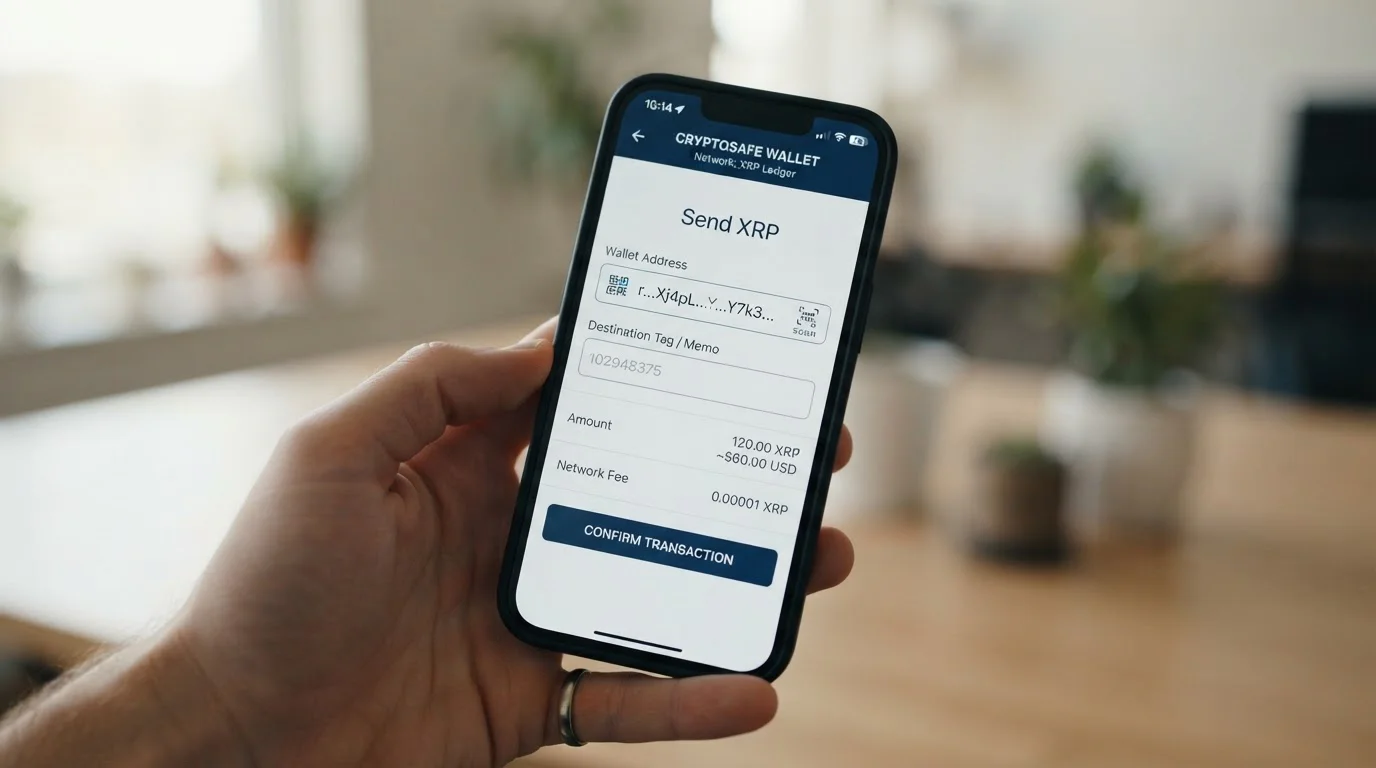
Casino cashiers that accept XRP show a deposit address and a destination tag when you select Ripple as your payment method. The address is a long alphanumeric string starting with an “r.” The destination tag is a shorter numeric string, usually nine or ten digits. Both are mandatory. The address tells the XRP Ledger where to send the transaction. The destination tag tells the casino’s pooled wallet which player account to credit. Miss the tag and the XRP arrives at the casino but does not arrive in your balance.
The deposit flow in your wallet: paste the casino’s address into the recipient field, paste the destination tag into the tag or memo field (some wallets call it a memo, some call it a destination tag, it is the same thing), enter the amount, confirm. The XRP Ledger finalises the transaction in three to five seconds. The casino’s system then picks up the incoming transaction and credits your balance, which usually takes another few seconds to a couple of minutes depending on how often the platform’s system checks the ledger before releasing the funds.
Mobile wallets sometimes hide the destination tag field behind a long-press or a manual toggle. If you do not see a tag input, check the wallet’s settings or help docs before sending. Desktop wallets and hardware devices usually surface it automatically. Double-check both the address and the tag before confirming. Blockchains do not have an undo button.
Understanding Destination Tags
The destination tag exists because most casinos do not generate a unique XRP address for every player. They use one pooled address for all incoming deposits, and the tag is the routing number that connects your transaction to your account. Exchanges work the same way when you deposit XRP: one address, thousands of customers, the tag does the sorting. Forget it and your deposit lands in a holding pattern where the casino’s finance team has to manually match the transaction to your account, assuming they can. Some platforms have streamlined recovery processes. Some do not. Some charge a recovery fee. Some decide it is not worth the support cost and the money stays lost.
This is not a theoretical edge case. Community forums are full of threads titled “sent XRP without destination tag, what now,” and the answers range from “contact support and wait” to “they never responded, funds gone.” The fix is simple: never skip the tag field, never assume it is optional, and always copy both the address and the tag directly from the casino’s deposit page rather than reusing an old one from a previous deposit. Casinos rotate tags periodically, and an expired tag sends your XRP into the same black hole as a missing one.
How long do XRP casino deposits and withdrawals actually take?
XRP ledger finality is three to five seconds, which marketing cites. Casino processing adds time: deposits credit in seconds to minutes once confirmed; withdrawals depend on the platform’s queue, KYC status and payout size. Small unverified amounts often clear in ten minutes, while larger sums or flagged accounts face manual review lasting hours or days.
Withdrawing XRP from Casinos
Withdrawal mechanics mirror deposits in reverse. Open the cashier, select XRP, enter your wallet address and destination tag if the receiving wallet requires one (most personal wallets do not, but double-check), specify the amount, confirm. The casino processes the request, which is where speed diverges from the three-to-five-second ledger promise. Small withdrawals from accounts that have not triggered any flags usually clear within ten minutes. Larger payouts, first-time withdrawals, or accounts showing play patterns the casino considers unusual get queued for manual review.
Manual review means a human looks at the account, checks for bonus abuse or multi-accounting, and decides whether to approve the payout or request identity documents. That process takes anywhere from an hour to several days. Some platforms frontload KYC and ask for a passport before you deposit. Some wait until you withdraw and spring it on you then. Neither approach is inherently better or worse; they just shift when the friction happens. The platforms that let you deposit without verification and then hold your withdrawal for documents are not doing anything illegal under their offshore licences. They are managing risk the way their compliance teams tell them to. It feels like a bait-and-switch from the player side because it is, functionally, exactly that.
Network Selection
Most XRP casinos use the native XRP Ledger exclusively. BC.Game is the exception: it offers XRPL, Binance Smart Chain’s BEP20 standard, and Ethereum’s ERC20 wrapped XRP. The three are not interchangeable. Send BEP20 XRP to an XRPL-only address and the funds do not arrive. Send XRPL XRP to a BEP20 address and the same thing happens. The casino lists which networks it accepts on the deposit page. If it does not explicitly mention BEP20 or ERC20, assume it only takes native XRPL and do not experiment.
BEP20 and ERC20 versions of XRP are wrapped tokens, not the original asset. They settle slower than the native ledger, cost more in fees (you pay Binance Smart Chain or Ethereum gas instead of XRPL’s fraction-of-a-cent rate), and exist mainly to let users move XRP through decentralised finance protocols that do not natively support the XRP Ledger. For a casino deposit, native XRPL is faster, cheaper, and simpler. Only pick an alternative network if the casino explicitly supports it and you have a specific reason to avoid XRPL.
What is a destination tag and what happens if I forget to include it?
A destination tag is an identifier telling a casino’s pooled XRP address which player account to credit. Forget it and your XRP reaches the casino but not your balance. Recovery needs a support ticket and sometimes a fee—some casinos help, others do not respond. Always copy both address and tag from the deposit page.

Offshore XRP Casinos vs UK-Licensed Sites: What You Trade Off
Choosing between a UK-licensed casino and an offshore XRP platform is not a neutral decision. It is a trade-off, and the dimensions of that trade-off are regulatory oversight, consumer protection mechanisms, dispute resolution pathways, and self-exclusion coverage. XRP support comes bundled with the offshore package, and understanding what else comes in that package matters before you deposit.
Regulation and Consumer Protection
A UK Gambling Commission licence means the operator is subject to the LCCP, which sets requirements for game fairness, advertising standards, responsible gambling tools, and transparent terms. The UKGC audits licensees, issues fines when they fail, and can revoke a licence if the failures are serious enough. The Advertising Standards Authority polices misleading promotions. The Independent Betting Adjudication Service handles disputes between players and operators at no cost to the player. None of that machinery extends offshore.
An offshore casino operating under a Curaçao licence is subject to whatever the Curaçao Gaming Authority chooses to enforce, and post-reform oversight is stricter than it used to be but still lighter than UKGC standards. An Anjouan-licensed casino answers to even less. A casino with no meaningful licence answers to no one except its payment processors and whatever reputational pressure the affiliate marketing ecosystem can muster. When something goes wrong at an offshore platform, you have two levers: the operator’s own support team, which may or may not respond, and public complaints on forums like AskGamblers or Trustpilot, which may or may not matter to the operator. That is a fundamentally different risk profile than playing at a site that can lose its UK licence if it mistreats you.
GamStop and Self-Exclusion
Every UK-licensed operator is integrated with GamStop, the national self-exclusion scheme. Register for a GamStop exclusion and every UKGC-licensed casino blocks you for the period you selected, which can be six months, one year or five years. The block is centrally coordinated and mandatory. Offshore casinos are not part of that system. They cannot be, because they do not hold UK licences. If you have an active GamStop exclusion and you register at an offshore XRP casino, the platform will not stop you. It has no access to the GamStop database and no obligation to check it.
Some sites market offshore casinos to UK players who are self-excluded as if that were a feature. It is not. It is a gap in the system, and offshore XRP casinos sit outside the exclusion by design, not by accident. If you registered with GamStop, the exclusion exists for a reason: an offshore site removes the block without adding any UK protection in its place. If you feel the pull to play while excluded, GamCare (0808 8020 133) and BeGambleAware offer free, confidential support.
Offshore platforms do offer their own self-exclusion tools. You can set deposit limits, session timers, cooling-off periods, or permanent account closures. None of that is centrally coordinated across operators, so excluding yourself at one platform does not exclude you at the next, and there is no external regulator verifying that the tools work as advertised. If responsible gambling infrastructure matters to you, the UKGC framework is stronger, and offshore tools are no substitute for it.
Are offshore XRP casinos legal for UK players?
Playing at offshore casinos is not illegal for UK residents. The Gambling Act 2005 regulates operators, not players. Offshore platforms are not licensed by the UKGC, which means they lack UK consumer protections, GamStop integration, and UK-approved dispute resolution. You are allowed to use them, but you leave the UK regulatory framework when you do.
KYC and Verification Requirements
UKGC operators frontload identity checks. Since May 2019 they must verify your age and identity before you can gamble, and they can ask for more when you withdraw larger sums. Offshore casinos vary. Some ask for documents up front. Most wait until you try to withdraw. A few let you deposit and play indefinitely without asking, then spring KYC on you when you cash out. That last model creates friction at the exact moment you want your money back, which feels designed to frustrate small withdrawals into abandoned balances. It probably is.
The documents requested are similar across both models: government-issued ID, proof of address, sometimes a selfie holding your ID, sometimes bank statements or screenshots proving where deposited funds originated. UKGC operators ask because the LCCP requires it. Offshore operators ask because their payment processors, banking partners, or licensing jurisdictions require it, or because the account triggered an internal compliance flag. Neither is inherently more or less invasive; the difference is timing and predictability. UKGC operators tell you the requirements before you start. Offshore operators tell you when they feel like it.
Dispute Resolution
A dispute with a UK-licensed casino that refuses a legitimate withdrawal or breaches its own terms goes through the operator’s complaints process first and can then be escalated to the Independent Betting Adjudication Service at no cost. The UKGC does not resolve individual complaints, but it can act against the licence. IBAS rulings are binding on the operator. The process is not fast, but it exists, it is free, and it has teeth. An offshore casino that does the same thing can be reported to its licensing jurisdiction, which may or may not investigate, and which has no obligation to respond to a complaint from a UK player. You can post on forums, escalate through affiliate sites that sent you to the casino, or hire a lawyer, but none of those routes are as structured or accessible as IBAS.
Some offshore casinos voluntarily submit to alternative dispute resolution services like eCOGRA or participate in complaint platforms like AskGamblers or Casinomeister, where their affiliate partnerships give them a reputational incentive to resolve issues publicly. That is better than nothing, but it is not the same as a statutory dispute mechanism backed by a regulator that can pull a licence.
Are XRP casinos safer than traditional online casinos?
It depends what you mean by “safer.” XRP casinos are offshore, outside UKGC oversight, so there are no UK consumer protections, no GamStop and weaker dispute resolution. Crypto transactions are fast and irreversible—good for speed, bad if you send to the wrong address. UKGC-licensed casinos offer stronger safeguards but do not accept XRP.
Game Access and Software Providers
UK-licensed casinos work with studios that hold UKGC-compatible certifications and comply with British advertising rules, which exclude some game mechanics and promotional structures that are common elsewhere. Offshore casinos pull from a wider pool, including studios that do not bother with UK compliance because they are not targeting the UK market through legal channels. That can mean access to games you will not find at a licensed UK site. It can also mean access to games with RTPs that have been quietly lowered, mechanics that are deliberately more volatile, or promotional structures that are designed to trap you in rollover requirements.
Provably fair games, the blockchain-verifiable originals like crash and dice that many crypto casinos promote, sit in a different category. They use cryptographic seeds that you can independently verify, which is a stronger transparency mechanism than the third-party RNG audits that traditional slots rely on. That does not make them “safer” in a consumer-protection sense. It makes them auditable in a way that a NetEnt or Pragmatic Play slot is not. Both can be fair. Both can be rigged. The difference is that one gives you the tools to check and the other asks you to trust the studio and the regulator.
| Feature | UKGC-Licensed Casinos | Offshore XRP Casinos |
|---|---|---|
| Regulatory oversight | UK Gambling Commission, LCCP compliance | Curaçao, Anjouan, or no meaningful licence |
| GamStop integration | Mandatory | Not integrated (bypass by design) |
| KYC timing | Frontloaded (before significant play) | Variable (often at withdrawal) |
| Dispute resolution | IBAS (free, binding) | Licensing jurisdiction (unresponsive) or voluntary ADR |
| Payment methods | Debit cards, e-wallets, bank transfers (no crypto) | Crypto including XRP, sometimes fiat |
| Consumer protections | Statutory (LCCP, ASA, IBAS) | Contractual (terms of service only) |
| Responsible gambling tools | Centrally coordinated (GamStop), UKGC-monitored | Per-platform, voluntary, not externally verified |

Why Use Ripple XRP for Casino Gambling?
XRP’s technical specifications solve problems that other cryptocurrencies create. Bitcoin takes an hour to reach irreversible finality and costs anywhere from one to five dollars per transaction when the mempool is busy. Ethereum averages thirty transactions per second and charges gas fees that spike into double digits when network demand rises. XRP settles fifteen hundred transactions per second, finalises in three to five seconds through deterministic consensus, and charges a hundredth of a penny per send. For a casino cashier, those numbers translate directly into user experience: no waiting, no guessing about fees, no refresh-the-page anxiety about whether your deposit will arrive before the odds change.
Speed
The XRP Ledger closes a ledger every three to five seconds. Once eighty percent of the validators on the Unique Node List agree on the state of that ledger, the transactions in it are irreversible. There is no probabilistic finality model where you wait for six confirmations to be “safe enough.” Three to five seconds is the ceiling, not the average. Compare that to Bitcoin, where even one confirmation takes ten minutes on average and exchanges typically wait for six, or Ethereum, where twelve seconds per block still leaves you waiting for enough blocks to pass that a chain reorganisation becomes statistically unlikely. For a casino deposit, that difference is the gap between “credited instantly” and “check back in an hour.”
Low Fees
XRP transaction fees are denominated in drops, which are millionths of an XRP. A standard transaction costs ten drops, which works out to 0.00001 XRP. At two dollars per XRP, that is two-thousandths of a penny. The fee is burned rather than paid to miners, which keeps it predictable. There is no congestion pricing, no mempool auction, no transaction sitting unconfirmed because you underestimated the gas. The fee is the fee, and it is low enough to be functionally free for any amount you would realistically deposit at a casino. Bitcoin’s Lightning Network can match that speed and cost, but Lightning requires channel management and liquidity routing that most casino cashiers have not implemented. XRP delivers the speed and cost at the base layer.
Privacy and Pseudonymity
XRP addresses are pseudonymous. They are not linked to your name or identity by default, and transactions between addresses do not carry personal information. That pseudonymity is weaker than privacy coins like Monero, where the transaction graph is intentionally obscured, but it is stronger than a debit card or bank transfer, where your name and account details are visible to the operator and logged by your bank. For players who value financial privacy, crypto offers a layer of separation between identity and play history that traditional payment rails do not.
That said, pseudonymity ends the moment you verify your identity with the casino. If you send XRP from a wallet tied to an exchange account that knows your name, and you later verify at the casino with the same name, the link is trivial to reconstruct. Pseudonymity is a feature of the blockchain, not a guarantee of anonymity in practice. If you want true privacy, you need operational security that most casual players do not maintain. And if the main appeal is keeping gambling off your bank statement, that is worth pausing on; it is often an early sign that play needs a closer look.
No Chargebacks
Cryptocurrency transactions are irreversible. Once a block containing your transaction is finalised, it cannot be undone. That is a feature for merchants, who do not have to worry about fraud chargebacks, and a risk for customers, who cannot reverse a mistaken payment. In a casino context, it cuts both ways. The operator cannot reverse your withdrawal after you have received it, which is a protection against bad-faith account freezes. You cannot reverse your deposit if you change your mind, which removes a safety net you have with a debit card or PayPal.
For casino operators, irreversibility reduces fraud risk, which is why crypto cashiers often come with lower rollover requirements or better promotional terms than card deposits. For players, it means you need to be certain about every send before you confirm it. There is no calling your bank. There is no dispute process. Once the XRP leaves your wallet, it is gone.
Global Accessibility
XRP moves across borders without friction. It does not care whether you are sending from a UK wallet to a Curaçao casino or from a German wallet to a Costa Rican sportsbook. The same three-to-five-second finality applies, the same fee structure, the same settlement mechanics. Traditional payment rails like debit cards and e-wallets get blocked, restricted, or surcharged when they cross jurisdictions, especially when the receiving merchant is in a grey-market category like offshore gambling. Crypto does not have that problem. The XRP Ledger does not distinguish between a payment to a casino and a payment to a coffee shop.
That global accessibility is why offshore casinos adopted crypto early and why they continue to prioritise it over fiat. It solves their banking problem. It does not solve yours: when a bank or card network will not process a payment to an operator, that is usually because the operator sits outside the regulation that would protect you.

Risks and Downsides of XRP Casino Gambling
Speed and low fees do not eliminate risk. They redistribute it, and some of the risks that come with offshore XRP gambling are structural rather than incidental. Understanding them is not about fear. It is about knowing where the system stops protecting you and where you are on your own.
Lack of UK Consumer Protections
Play at a UKGC-licensed casino and you have statutory protections: terms that cannot be changed retroactively, a regulator that audits fairness, a free dispute resolution service if something goes wrong, and a licensing system that pulls operators who misbehave. Play at an offshore XRP casino and those protections do not exist. The operator can change its terms at any time with or without notice, the regulator may not respond to your complaint, and if the platform decides not to pay you, your leverage is a forum post and a bad review. That is not theoretical. Players report confiscated balances, closed accounts, and ignored withdrawal requests every week on communities like AskGamblers and Casinomeister.
Most offshore operators are not actively malicious. They are indifferent, and indifference becomes hostile the moment you represent more cost than value. A dispute over a hundred-pound withdrawal at a UKGC casino gets escalated to IBAS at no cost to you and gets resolved in weeks. The same dispute at an offshore platform gets you a canned reply from support, maybe, and then silence.
Destination Tag Errors
Forget to include a destination tag when depositing XRP and your funds land in the casino’s pooled address without an account to credit them to. Recovery depends entirely on the platform’s support infrastructure and willingness to manually match your transaction. Some casinos streamline this. Some charge a recovery fee. Some do not respond. The XRP did not vanish from the blockchain. It is sitting in the casino’s wallet. But it is not sitting in your balance, and the gap between those two states can stretch into days or weeks of support tickets, or it can stretch into permanent loss if the casino decides the recovery is not worth the admin cost.
This risk is entirely avoidable by copying both the address and tag from the casino’s deposit page every time, but it is common enough that every XRP casino community has multiple threads about it, and common enough that some casinos bury the tag requirement in small print rather than surfacing it prominently in the deposit flow. That is a design choice, and it is not a player-friendly one.
Price Volatility
XRP is a cryptocurrency, which means its price moves. A fifty-XRP deposit might be worth a hundred pounds today and ninety pounds tomorrow. That volatility cuts both ways: a win paid in XRP that appreciates before you cash out is a larger win in pound terms, and a loss incurred in XRP that depreciates is a smaller loss. But most players think in their local currency, and watching the value of a withdrawal shrink by ten percent while it sits in your wallet waiting for you to cash out feels like a second loss on top of the one the casino already handed you.
Some platforms auto-convert deposits to a stablecoin like USDT or to dollars at the moment you fund your account, which removes the volatility from the playing experience but adds a conversion step and a potential spread that eats into your balance. Other platforms keep everything denominated in the cryptocurrency you deposited, which preserves the upside if the price rises but exposes you to the downside if it falls. Neither model is wrong. They are just different risk profiles, and you should know which one the casino uses before you deposit.
KYC Surprises on Withdrawal
Offshore casinos that let you deposit without identity verification are not doing you a favour. They are deferring a cost until the moment you try to withdraw, at which point the request for documents feels like a hostage situation. You cannot get your money out until you send a passport scan, a utility bill, and sometimes a selfie holding your ID next to today’s date. The casino always had the leverage. It just waited until you were committed to exercise it.
This is not universal. Some platforms ask for documents before you deposit and are transparent about the requirement. But the “deposit freely, verify on withdrawal” model is common enough that it should be assumed unless the casino explicitly states otherwise. Budget for a delay of anywhere from hours to a week the first time you cash out, and longer if the platform decides your documents are unclear or if its compliance queue is backed up.
Limited Recourse for Disputes
When a UKGC-licensed casino refuses to pay a legitimate win, you escalate to IBAS. IBAS reviews the case, issues a binding ruling, and the operator complies or loses its licence. When an offshore casino does the same, you post on forums, you complain on Trustpilot, you email the licensing jurisdiction if one exists, and you hope someone cares. Most of the time, no one does. The platforms that maintain affiliate relationships have a reputational incentive to resolve complaints publicly, because a bad review on a high-traffic affiliate site costs them player referrals. The platforms that do not care about affiliates, or that operate without a meaningful licence, do not have that incentive.
You can hire a lawyer, but legal action against an offshore casino domiciled in Curaçao or incorporated in an anonymous jurisdiction costs more than most disputed withdrawals are worth. The gap between what is technically possible and what is practically achievable is the risk you accept when you deposit at a site outside your own country’s legal framework.
What’s the difference between provably fair games and regular online slots at XRP casinos?
Provably fair games (crash, dice, plinko) use cryptographic seeds you can independently audit to confirm outcomes were not manipulated. Regular slots like Pragmatic Play use RNG certified by third-party labs such as eCOGRA, which you cannot verify yourself. Both can be fair; provably fair lets you check, RNG asks you to trust the auditor.
Provably Fair vs RNG Certification
Crypto casinos often promote “provably fair” games as a transparency feature. These are typically in-house originals like crash, dice, plinko, or mines, where the outcome is determined by a cryptographic seed that you can verify independently. The casino publishes the hashed seed before the round starts, you supply a client seed, the two are combined to generate the result, and after the round ends you can check that the server seed matches the hash and that the outcome was calculated correctly. That is genuine transparency. If the casino cheats, you can prove it.
Regular online slots from studios like Pragmatic Play, NetEnt, or Evolution use random number generators certified by third-party testing labs like eCOGRA, iTech Labs, or GLI. The RNG is audited periodically to confirm it produces results within expected statistical ranges, but you as a player cannot verify any individual spin. You trust the studio, the testing lab, and the licensing jurisdiction that requires the certification. That is a different trust model than provably fair, and it is the same model used by every licensed casino in Europe, including UKGC operators.
Neither model is inherently better or worse. Provably fair is more transparent at the level of individual game rounds. RNG-certified is backed by external audits and regulatory oversight that extend beyond the game itself. Most crypto casinos mix both: they run provably fair originals alongside RNG-certified slots from mainstream studios, and they do not always label which is which. If transparency matters to you, stick to the originals. If you want the deeper game catalogues and higher production values that come from studios like Pragmatic or Evolution, you are back in the RNG-certified world whether the casino is licensed or offshore.
Bonuses and Promotions at XRP Casinos
Offshore crypto casinos compete on deposit bonuses the way licensed operators compete on game libraries. The offers range from sensible to theatrical, and the difference between a good deal and a rollover trap is usually buried three paragraphs into the terms.
How XRP Deposits Count Towards Welcome Bonuses
Most offshore casinos treat XRP the same as Bitcoin, Ethereum, or any other cryptocurrency when calculating bonus eligibility. If the platform advertises a welcome package, crypto deposits usually qualify unless the terms explicitly exclude them, which is rare. What varies is the structure. Some platforms offer a percentage match on your first deposit: deposit fifty XRP, get fifty more as bonus funds. Some offer free spins on specific slots. Some, like FortuneJack, skip the cash bonus entirely and give you a pile of no-wager spins instead.
Percentage-match bonuses come with wagering requirements, which specify how many times you need to turn over the bonus amount before you can withdraw it. A hundred-percent match up to one Bitcoin with a thirty-times wagering requirement means you need to wager thirty Bitcoin worth of bets before the bonus converts to withdrawable cash. That is a volume commitment, and it is designed to extract house edge over time rather than hand you free money. Free spins often come with their own rollover requirements on the winnings, caps on how much you can win, and restrictions on which games count toward clearing the requirement.
Do XRP deposits qualify for casino welcome bonuses?
Yes, most offshore crypto casinos that accept XRP treat it the same as other cryptocurrencies for bonus eligibility. Deposit bonuses, free spins, and welcome packages usually apply to XRP unless the terms explicitly exclude it, which is uncommon. Check the specific platform’s terms for wagering requirements and game restrictions before accepting.
Crypto-Specific Bonus Terms
Crypto bonuses at offshore casinos sometimes come with looser terms than fiat bonuses at the same platform, because irreversible payments carry less fraud risk for the operator. You might see lower rollover multipliers, higher maximum bet limits while the bonus is active, or fewer restricted games. That is not universal, but it is common enough to be worth checking. The flip side is that crypto bonuses also sometimes come with tighter cashout caps: win five hundred pounds from bonus funds, and the terms might cap your withdrawal at two hundred, with the rest forfeited.
The promotional structures at high-volume platforms like Stake and BC.Game lean into ongoing rewards rather than front-loaded welcome packages. Rakeback programs return a percentage of the house edge on your wagers as cash regardless of whether you win or lose, which is a more sustainable value proposition than a one-time match bonus that expires after your first deposit. VIP tiers unlock reload bonuses, cashback rates, and dedicated account managers. If you are going to play long-term, the ongoing structure usually delivers more value than the headline welcome offer, but it requires volume to unlock.
Best XRP Casino Welcome Offers
Bitstarz runs a hundred-and-eighty free spins on first deposit, structured as no-wager spins, which is cleaner than most bonus deals. TrustDice headlines at three Bitcoin across three deposits, but the terms restrict it heavily. Cloudbet spreads up to twenty-five hundred dollars over thirty days tied to play volume, which is a grind but at least transparent about it. FortuneJack’s promo code unlocks a hundred no-wager spins on a twenty-euro deposit, which is small but genuinely wager-free. BC.Game does not advertise a flashy welcome number, but its rakeback and level system pay out consistently if you play regularly.
None of these are “free money.” They are all structured to return value only if you hit certain play thresholds, and the house edge works in the background the entire time. The cleanest offers are the ones with no rollover requirement, even if the headline number is smaller, because you keep what you win without jumping through hoops.
Ongoing Promotions and VIP Programs
Weekly reload bonuses, cashback on losses, level-based rewards, tournament entries, and random drops populate the promotions calendars at most offshore XRP casinos. Stake runs daily and weekly challenges that pay out in cash rather than bonus funds locked behind rollover requirements. BC.Game’s BCD token feeds into a staking ecosystem where holding the token generates yield on top of your regular play. 7Bit focuses on smaller weekly reloads instead of one large welcome package. mBit and Bitstarz both run frequent slot tournaments with real-money prize pools.
VIP programs typically tier by wagered volume, with each level unlocking higher cashback rates, faster withdrawals, dedicated support, and invitations to exclusive promotions. Getting there requires betting tens of thousands of pounds equivalent over weeks or months, so the perks are not accessible to casual players, but they do represent genuine value if you are a high-volume user. The catch is that chasing VIP status often means playing past the point where you should have stopped, which is exactly what the program is designed to encourage.
Games Available at Ripple XRP Casinos
Offshore crypto casinos pull from a broader game library than UKGC-licensed sites because they work with studios that do not bother obtaining UK certification. That breadth is not always an advantage. Some of the lesser-known providers deliver games with RTPs that have been quietly shaved down, volatility tuned to drain balances faster, or mechanics designed to create near-miss illusions that feel like wins but pay nothing. The recognisable studio names remain safer bets.
Slots
Slot libraries at the platforms listed above run from three thousand titles at the smaller end to ten thousand at the larger. Pragmatic Play, NetEnt, Evolution, Play’n GO, Nolimit City, and Push Gaming show up consistently, alongside smaller studios like Booming Games, Wazdan, and Endorphina that focus on the crypto casino market. RTP information is published for most mainstream titles, though not always surfaced in the browsing interface. mBit’s sortable RTP filter is the exception rather than the rule.
Volatility, hit frequency, and maximum win potential vary widely. High-volatility slots pay infrequently but offer larger potential wins. Low-volatility slots pay more often but in smaller amounts. Neither is better or worse; they are different risk profiles. Crypto casinos tend to feature more high-volatility titles than licensed UK sites, possibly because the player base skews toward higher-risk appetites, possibly because the studios targeting offshore operators lean that way. Pay attention to the RTP and volatility rating if the game lists them. If it does not, you are flying blind.
Live Dealer Games
Evolution Gaming dominates live dealer floors across both licensed and offshore casinos, and its presence at a crypto platform is often a signal that the operator is paying for quality. Pragmatic Play Live and Ezugi cover the mid-tier. Smaller studios like LuckyStreak and Vivo Gaming fill out the catalogue. Blackjack, roulette, and baccarat are universal. Poker variants, game shows like Crazy Time and Monopoly Live, and localised roulette tables with native-language dealers add variety for players who want more than the basics.
Minimum and maximum bet limits vary by table. Crypto casinos often run higher-limit tables than licensed sites, which suits high rollers but can create problems for players who do not realise they have accidentally sat down at a table with a fifty-pound minimum. Live dealer games do not contribute equally to bonus wagering requirements. Many platforms exclude them entirely or count them at ten or twenty percent, so if you are trying to clear a bonus by playing live blackjack, check the terms first.
Table Games
RNG-based blackjack, roulette, baccarat, and video poker round out the table game offerings. These are faster than live dealer equivalents and usually carry lower minimums, which makes them better for clearing bonuses if the terms allow. The trade-off is that you are trusting the RNG rather than watching a physical wheel or deck. For players who prefer the illusion of control that comes from seeing cards dealt or a ball spun, RNG table games feel sterile. For players who want speed and lower stakes, they are the practical choice.
Provably Fair Originals
Crash, dice, plinko, mines, limbo, keno, and other simple probability games built by the casino itself rather than licensed from a studio. These use the provably fair system described earlier, where you can verify that the outcome was not manipulated after the fact. The transparency is real. The house edge is still there, usually in the two-to-five-percent range depending on the game and the bet structure. Provably fair does not mean “more likely to win.” It means “auditable.”
BC Originals at BC.Game, Stake Originals at Stake, and similar in-house libraries at Cloudbet and TrustDice give these games prominent placement, often above the slot catalogue. They are lightweight, fast, and built for mobile. They also tend to have higher hit frequencies than slots, which creates a false sense of momentum even as the house edge quietly grinds your balance down. If you enjoy them, fine. If you are playing them because you think the transparency makes them safer bets, you are confusing fairness with probability.
Sportsbook Integration
Stake, BC.Game, Cloudbet, and FortuneJack all run sportsbooks alongside their casinos, with single-wallet integration that lets you move funds between the two without manual transfers. Pre-match and live betting cover football, tennis, basketball, esports, and dozens of other sports. Odds formats switch between decimal, fractional, and American depending on your preference. Bet builders let you combine multiple selections from the same match into one wager at combined odds.
XRP works the same way in the sportsbook as it does in the casino: fast deposits, fast settlement, destination tags required. The cashout mechanics differ slightly, because sportsbooks sometimes hold payouts until the event is graded and any potential disputes are resolved, which can add hours or days to the timeline. That is not unique to crypto books. It is how sports betting works everywhere. The crypto part just determines how fast the money moves once the bet is settled.
Mobile XRP Casino Gaming
Every casino listed in this guide runs in a mobile browser. None require a downloaded app, because offshore operators serving UK players do not distribute apps through the Apple App Store or Google Play Store. Apple and Google both restrict real-money gambling apps to operators licensed in the jurisdiction where the user is located, which excludes every offshore platform by definition. The workaround is progressive web apps and mobile-optimised sites, which deliver most of the same functionality without requiring App Store approval.
Open any of these casinos in Safari on an iPhone or Chrome on an Android device and the layout adjusts to the screen size automatically. Game catalogues, cashier functions, live chat, and account settings all work. Slots load in portrait or landscape depending on how the studio built them. Live dealer games default to portrait with the video feed on top and controls below. Depositing XRP from a mobile wallet app involves copying the address and destination tag from the casino’s cashier, switching to your wallet app, pasting both fields, and confirming. QR codes streamline this on some platforms: scan the code with your wallet app and the address and tag populate automatically.
Touch interfaces can be finicky on complex slot bonus rounds or live dealer games with multiple betting options, but most modern studios design for mobile first. Load times depend on your connection more than the casino’s servers. If you are on 4G or 5G, everything runs smoothly. On 3G or a congested Wi-Fi network, expect delays, especially on live dealer tables where video streams eat bandwidth.
One practical note: mobile browsers do not persist login sessions as reliably as desktop browsers, so you may find yourself re-entering credentials more often than you would on a laptop. Two-factor authentication, if the casino offers it, adds a step but keeps your account more secure, which matters when you are logging in from public networks or shared devices.

How to Choose the Right XRP Casino
Licence type, XRP-specific features, withdrawal speed reality, game library depth, and bonus terms transparency are the five dimensions worth checking before you fund an account. No platform scores perfectly across all five, so the question is which trade-offs you can live with.
Licence and Reputation
Curaçao licences post-December 2024 reform are stronger than Anjouan licences, which are stronger than no licence at all. A casino operating under direct Curaçao Gaming Authority oversight has reporting requirements and a regulatory body that can be contacted, even if that body is less responsive than the UKGC. An Anjouan licence is a piece of paper that costs money to obtain and proves little beyond “someone paid the fee.” No licence means the operator is running on reputation and infrastructure alone, which works until it does not.
Operational history matters more than licence jurisdiction in practice. A platform that has processed payouts smoothly for five years is a better bet than a newly licensed operator with no track record. Check forum complaints, not just affiliate reviews. AskGamblers, Casinomeister, Trustpilot, and Reddit’s gambling communities surface unresolved disputes that glossy review sites skip. A casino with a hundred one-star Trustpilot reviews and no operator responses is telling you something. A casino with mixed reviews but consistent operator engagement at least has a support function that answers.
How do I buy XRP in the UK to use at online casinos?
Exchanges serving UK customers, such as Coinbase, Kraken and Bitstamp, sell XRP and accept GBP by bank transfer or debit card. Open an account, complete identity verification (five minutes to a day), deposit pounds, buy XRP, then withdraw to your personal wallet. Fees are typically one to two percent plus a flat withdrawal fee.
XRP-Specific Features
Minimum deposit amounts, destination tag clarity, network support, and withdrawal processing speed vary enough across platforms that they should factor into your choice. BC.Game’s 0.001 XRP minimum lets you test the platform for pennies. Stake’s ten-XRP floor is higher but still accessible. 7Bit’s twenty-five-XRP threshold starts to feel like a commitment before you know whether the site suits you.
Destination tag handling separates good cashier interfaces from bad ones. A platform that surfaces the tag prominently, auto-copies both address and tag with one click, and explains what happens if you forget it is treating you like a human. A platform that buries the tag in small print, does not mention recovery processes, and makes you hunt through three help articles to understand what went wrong when your deposit does not credit is treating you like a liability. Test the cashier flow on the deposit page before you send real money. If it feels unclear, that is not your fault.
Three-network XRP support at BC.Game is overkill for most users, but it is a signal that the platform takes crypto infrastructure seriously. Single-network XRPL-only sites work fine. Just do not send BEP20 or ERC20 to them, because it will not arrive.
Withdrawal Speed Reality
Ledger settlement is three to five seconds. Casino processing is anywhere from ten minutes to three days depending on account status, payout size, and how backed up the compliance queue is. Platforms that advertise “instant withdrawals” are talking about the ledger, not their own internal approval time. Small unverified withdrawals at Stake, BC.Game, Bitcasino, and Bitstarz clear in under ten minutes most of the time. Larger payouts or first-time cashouts trigger review queues that stretch into hours or overnight. Accounts flagged for bonus abuse, multi-accounting, or play patterns the casino considers unusual get held longer.
No offshore platform publishes the exact thresholds that trigger manual review, because publishing them would let abusers stay just under the line. You learn the threshold by hitting it. Budget for a delay the first time you withdraw, and longer if the amount is significant. If speed matters, pick a platform with a track record of fast small payouts and do not deposit more than you can afford to have locked for a week if something goes wrong.
Game Library Depth
Bigger is not always better, but three thousand games give you more variety than three hundred, and ten thousand is overkill unless you actively enjoy hunting for obscure titles. The quality threshold is whether the casino stocks games from recognisable studios. Pragmatic Play, NetEnt, Evolution, and Play’n GO are everywhere because they deliver reliable RTPs and polished interfaces. If those names are missing and the library is full of studios you have never heard of, that is not automatically a red flag, but it does mean you are trusting the casino’s curation rather than relying on brands with established reputations.
Live dealer coverage from Evolution or Pragmatic Play Live is a positive signal. In-house provably fair originals are fine if you enjoy them, but they are not a substitute for a deep third-party catalogue. Check whether the casino surfaces RTP information in the game browsing interface. If it does, that is pro-transparency. If it does not, you are guessing about which slots are tight and which are loose.
Bonus Terms Transparency
Headline numbers sell, but terms determine whether a bonus is worth claiming. A three-Bitcoin welcome offer with sixty-times wagering and a fifty-pence maximum bet while the bonus is active is a trap, not a gift. A hundred no-wager free spins with a fifty-pound cashout cap is a small offer, but you keep what you win up to that cap with no rollover. The second offer is better for most players.
Crypto bonuses often exclude certain games from counting toward rollover, cap how much you can bet per spin, or restrict which games you can play entirely while the bonus is active. Progressive jackpot slots, live dealer games, and high-RTP table games like blackjack are commonly excluded or weighted at ten to twenty percent of their actual wagered amount. Read the full terms before you accept a bonus. If they are not linked clearly on the promotions page, that is a yellow flag. If they contradict the marketing copy, that is a red flag.
Some platforms let you toggle bonuses off so deposits go straight to your real-money balance with no strings. That is the cleanest route if you do not want to deal with rollover requirements. If the casino does not offer that option, depositing exactly the amount you want to play with and declining any bonus prompts keeps things simple.
Responsible Gambling at Offshore Casinos
Offshore XRP casinos offer deposit limits, session timers, cooling-off periods, and self-exclusion tools, but none of it is externally verified, centrally coordinated, or backed by a regulator that enforces compliance. You set a deposit limit and the casino honours it, or it does not, and you have no recourse if it fails. You self-exclude and the platform blocks your account, or it lets you reopen it with a support ticket, and no one is checking.
That is not to say the tools are fake. Most platforms implement them genuinely, because doing so costs little and avoids bad press. But the absence of external oversight means you are trusting the operator’s goodwill rather than relying on statutory protections. UKGC operators face fines and licence reviews if their responsible gambling tools fail. Offshore operators face nothing except reputational damage, which only matters if they care about reputation.
If you know you have a problem with gambling, the safest route is to register for a GamStop exclusion. GamStop blocks you across every licensed operator for six months, a year, or five years. If you are on GamStop and reading this guide, please do not treat offshore casinos as a way round it: the exclusion exists for a reason, and offshore sites give you no UK protection at all. GamCare (0808 8020 133) and BeGambleAware can help you through the exclusion period.
Offshore platforms cannot block you from opening accounts at other offshore platforms. Self-exclusion is per-site, and no central database coordinates across operators. If you self-exclude at Stake, you can still sign up at BC.Game five minutes later. That lack of coordination is a real risk if the thing you need most is a barrier you cannot easily remove.
UK-based problem gambling resources remain available regardless of where you play. GamCare, BeGambleAware, and the National Gambling Helpline offer free confidential support, and they do not ask whether you were playing at a licensed or offshore site. If you need help, those services exist. Using them is not an admission of failure. It is the practical step that precedes getting your money under control.
Offshore XRP casinos are accessible, fast, and outside the restrictions that UK-licensed operators face. They are also outside the protections. That is the trade. Speed for safety, access for oversight, pseudonymity for recourse. Some players make that trade knowingly and manage it fine. Some make it without understanding the costs, and by the time they do, they are already past the point where turning back is easy. Which category you fall into is not something an article can determine for you. It is the question worth answering before you copy that first deposit address.
Crypto Casinos UK 2026 — Bitcoin Cash, Solana, XRP and More
Content created by the «casinopayoptions-uk.com» team