
BNB Casino Comparison UK 2026: The Offshore Reality Check
 Available in GB
The UK Gambling Commission does not license a single casino that accepts BNB. The reason sits in regulation, not technology: UKGC operators must trace every deposit back to a verified bank account, and a blockchain wallet breaks that chain. UK players who want to gamble with Binance Coin turn offshore—to Curaçao-licensed platforms, Anjouan operators, or sites with no licence at all.
This is the practical map: which BNB casinos UK residents actually use, how they compare, what you trade off when you step outside UKGC jurisdiction, and how to verify the licence behind the landing page. Seven operators compared, licensing checked against public validators where they exist, and withdrawal claims set against published terms and player reviews. No fluff about “the future of crypto gambling”—what works now, what carries risk, and what the law actually says about a UK player on an offshore site.
BNB moves fast and costs almost nothing to transfer. A deposit on BNB Smart Chain confirms in under a minute and the network fee sits below ten pence. That speed advantage vanishes if the operator holds your withdrawal for manual review, converts your BNB to a stablecoin you never asked for, or cites a terms clause you missed when you try to cash out. The comparison below names names, surfaces red flags where they exist, and gives you enough specifics to pick an operator that matches your risk appetite.
Why UK Players Turn to BNB Casinos
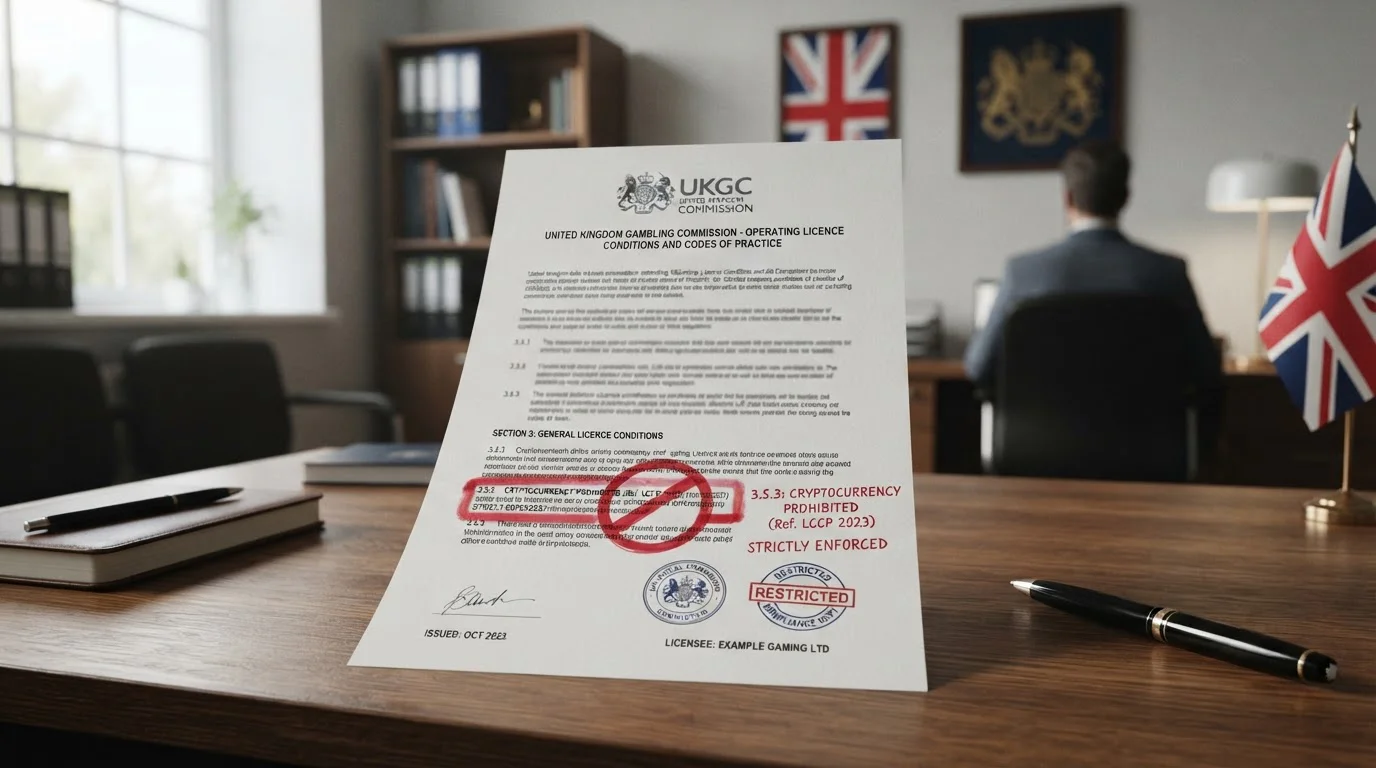
No UKGC-licensed casino will take your BNB. The prohibition flows from the Licence Conditions and Codes of Practice: customer payments must move through a method that gives a clear, traceable link to a verified bank account. A cryptocurrency wallet gives the operator an address, not a bank statement. The UKGC’s 2023 White Paper consultation confirmed this position and proposed no changes.
This is not about the technology being unsafe. The UKGC’s concern is source-of-funds verification and anti-money-laundering compliance. A bank account sits in someone’s name, with KYC done by the bank. A wallet address belongs to whoever controls the private key, and the operator sees only an alphanumeric string. The regulator will not budge on traceability, so UKGC operators cannot accept crypto deposits directly. Some will take fiat funded from crypto—you convert BNB to GBP on an exchange, then deposit pounds—but that is not a “BNB casino” in any practical sense, because your coins never touch the casino cashier.
The offshore platforms that do accept BNB operate under Curaçao, Anjouan or no licence. They advertise to UK players despite Section 33 of the Gambling Act 2005, which criminalises offering gambling to GB residents without a UKGC licence. The law targets the operator, not the player. No UK resident has been prosecuted for using an offshore casino. The enforcement risk sits with the platform, and offshore operators judge that risk acceptable. You, the player, sit outside UK consumer protection when you register.
The tradeoff is plain: offshore BNB casinos give you instant deposits, no monthly caps, no GAMSTOP linkage, and withdrawal speeds UKGC sites cannot match. You give up the UKGC’s funds-protection disclosure rules, independent ADR through IBAS or eCOGRA, and the backstop of a UK licence that can be revoked. When an offshore operator decides your account breaches terms, your recourse is the operator’s own complaints process. That asymmetry shapes every decision below.
Why don’t UKGC-licensed casinos accept BNB or other cryptocurrency?
UK anti-money-laundering rules require operators to trace customer funds back to a named, identity-checked bank account. A cryptocurrency wallet address reveals no legal identity, so it cannot meet that standard. The UKGC has held this position consistently since 2018 and reaffirmed it in the 2023 White Paper, with no near-term change expected.
The 7 BNB Casinos UK Players Actually Use
The table below ranks offshore operators by licensing tier, operational history, and withdrawal performance. Every platform accepts BNB on BNB Smart Chain (BEP-20). None holds a UKGC licence. Licensing, game counts, and withdrawal speeds are taken from operator terms, public registers, and live player reviews as of autumn 2026.
| Operator | Licence | BNB Network | Withdrawal Speed | Distinguishing Feature |
|---|---|---|---|---|
| Cloudbet | Curaçao OGL/2024/328/0599 | BEP-20 | No cap once verified | Binding independent adjudicator in ToS |
| Bitcasino.io | Anjouan ALSI-202509076-F12 | BEP-20 | ~2 minutes average | RTP shown on every slot thumbnail |
| TrustDice | Curaçao OGL/2024/664/0280 | BEP-20 | Seconds (TRON/BSC rails) | Post-LOK licence (verifiable via new validator) |
| Stake.com | Curaçao OGL/2024/1451/0918 | BEP-20 | Instant-10 minutes | No welcome bonus, VIP/rakeback only |
| mBit Casino | Curaçao (disputed/pre-LOK) | BEP-20 | ~10 minutes | 325% + 4 BTC welcome package |
| BC.Game | Anjouan (post-Curaçao) | BEP-20 | 10-30 minutes, €10k cap | 10,000+ games, $2.1M court-confirmed claims |
| Rollbit | Anjouan | BEP-20 | Instant (best-in-class) | Futures desk, $123M Ukrainian seizure |
The ordering reflects a risk gradient, not a quality ranking. Cloudbet and Bitcasino sit at the top because their terms are clearer, their licence numbers are published (Cloudbet’s verifies on the Curaçao validator), and independent reviews converge on consistent payout behaviour. BC.Game and Rollbit sit at the bottom not because the product is weak—both offer deep game libraries and genuinely fast withdrawals—but because court records and asset seizures are public, and any player depositing there should know what they are walking into.
Cloudbet
The oldest name on the list, taking Bitcoin bets since 2013. Halcyon Super Holdings B.V. operates the platform under Curaçao licence OGL/2024/328/0599, verifiable on the new Curaçao validator that launched with the LOK reform in December 2024. Cloudbet accepts 29 cryptocurrencies, BNB included, and pays out with no stated ceiling once your account is fully verified. Verification usually means ID and proof of address at the first withdrawal, sometimes earlier if your deposit crosses an internal threshold the terms do not publish.
The cashback model is the hook: 10 percent of the house edge back on every casino bet for your first 30 days, paid as cash that can leave the account whenever you want. Cloudbet advertises the package at up to 2,500 dollars. The “up to” matters—it is 10 percent of house edge, not 10 percent of turnover, so the actual cash-back depends on what you play and how much you lose. A slot with 4 percent house edge paying back 10 percent of that edge returns 0.4 percent of your wager. Play through 625,000 dollars at that rate and you hit the 2,500-dollar ceiling. The maths is honest, but you need to run it yourself.
What sets Cloudbet apart is the independent adjudicator clause in the terms. If a dispute escalates and the operator’s internal process does not satisfy you, the ToS names a third party whose decision binds the casino. This is rare—most offshore operators reserve final say for themselves. The adjudicator is not free, and the clause comes with procedural hoops, but it exists. For a player outside UK jurisdiction, that is the closest thing to independent ADR you will find at a crypto casino.
Bitcasino.io
EZ Spins Ltd. launched Bitcasino in 2014 and brands it as the first licensed Bitcoin casino. The current licence, ALSI-202509076-F12 issued 30 September 2025, appears to be Anjouan-based judging by the prefix, though the operator does not publish the jurisdiction on the front page. Anjouan licences sit one tier below Curaçao in terms of regulatory oversight—there is no central validator, no published dispute-resolution framework, and the licensing authority itself operates with limited transparency.
The product, though, is solid. Five thousand games, 150-plus live tables, and withdrawal processing that averages two minutes from request to blockchain confirmation. That speed claim is consistent across multiple independent reviews, and it shows in the Trustpilot pattern: complaints centre on bonus terms and KYC hassles, not on withdrawals being held. When an operator can move money out in two minutes, it usually does.
Bitcasino displays RTP on every slot thumbnail. This has been policy since 2014, long before RTP transparency became a talking point in the sector. The figure you see is the one the studio published, and you can sort the entire library by it. If you are the kind of player who weighs a 96.5 percent RTP against a 94.2 percent one, this is the interface for you. The tradeoff is the Anjouan licence—lighter oversight than Curaçao, no route to independent review if a dispute goes sideways.
TrustDice
Satoshi Gaming Group N.V., Curaçao Chamber of Commerce registration 151832, relicensed under the reformed LOK framework on 16 July 2024. The licence number is OGL/2024/664/0280, and it checks out on the new Curaçao validator at validation.gaming-curacao.com. This matters because the LOK reform in December 2024 replaced the old master-licence system—where a handful of operators held master licences and sublicensed to hundreds of platforms—with direct oversight by the Curaçao Gaming Authority. Operators on post-LOK licences underwent fresh vetting. Those still running on pre-LOK sublicences either did not apply or did not qualify.
TrustDice runs on TRON and BNB Smart Chain rails, and withdrawals clear in seconds when the blockchain is not congested. The three-BTC welcome package sounds enormous until you read the wagering terms—usually 40x to 50x, depending on the game category. A 90,000-dollar bonus at 40x wagering means 3.6 million in turnover before a withdrawal clears. That is realistic for a whale, impossible for a casual player. The free faucet and TXT token staking are more useful for most depositors: small amounts of free crypto to test the platform, and a staking program that pays yield on the house token if you hold it.
The platform is VPN-permissive. The terms do not ban VPN use outright, and player reviews confirm accounts from restricted territories have not been closed solely for routing through a VPN. That permissiveness is a policy note, not a recommendation: routing around an ISP block or a geo-restriction does not add any protection, and studios enforce their own regional restrictions regardless of what the casino tolerates. Play from your real location and treat any VPN clause in the terms as a reason a withdrawal could be questioned.
Stake.com
Medium Rare N.V. operates Stake under Curaçao licence OGL/2024/1451/0918. The platform launched in 2017, grew into one of the highest-traffic crypto casinos globally, and runs a separate US-facing sweepstakes product at Stake.us that has no connection to the offshore site. The licence validator shows the OGL number as active, with a note “Assessment in progress” as of September 2026. Leaked Curaçao Gaming Authority records published in 2025 revealed the licence was granted before ownership questions around Ed Craven and Bijan Tehrani were fully resolved. That administrative mess does not mean the product is unsafe, but it does mean the licensing process was rushed.
Stake does not offer a deposit match. The welcome structure is rakeback and VIP tiers, not a percentage bonus. New players get nothing beyond the standard 1x deposit turnover requirement before withdrawal. The VIP ladder pays better the more you wager, and prize races distribute cash pools to top performers each week. If you are used to a 100 percent or 200 percent match on first deposit, Stake will feel stingy. If you are a regular who turns over volume, the rakeback compounds faster than bonus terms at competing platforms.
Three thousand games from 73 studios, instant to ten-minute withdrawals with no stated cap once you are verified, and high-profile sponsorships (UFC, Formula 1) that lend the brand a veneer of legitimacy. The terms reserve the right to request extensive KYC—source of funds, bank statements, video call—at any withdrawal. When that verification lands, it is thorough. Player reviews split: half praise the speed and product, half complain about sudden KYC requests that freeze withdrawals for days. The pattern suggests Stake triggers enhanced checks algorithmically, possibly on win size or account age. Budget time for that if you hit a large withdrawal.
mBit Casino
Dama N.V. operates mBit, claiming a Curaçao licence. The licence status is disputed. The operator lists itself as Curaçao-licensed on the site footer, but independent reviewers have flagged mBit as operating without a valid gambling licence. The discrepancy likely stems from the old master-licence system: Dama may hold a pre-LOK sublicence that was not renewed under the LOK framework, or it may have lost its licence and not updated the footer copy. The new Curaçao validator returned no match for “mBit Casino” or “Dama N.V.” as of autumn 2026.
The product itself has been live since 2014. Twenty-five hundred games, heavy on slots, RTP displayed on every thumbnail in the same style Bitcasino pioneered. The 325 percent welcome bonus stretching up to four BTC is the highest percentage match in this comparison, but the wagering requirement scales with it—expect 40x or higher. Withdrawals average ten minutes according to player reviews, and the Stellar Club loyalty program rewards regulars with cashback and reload bonuses once the welcome phase ends.
The licensing ambiguity is the catch. If the Curaçao licence is genuinely valid, it should appear on the new validator. If it does not, the platform is either unlicensed or operating on an expired sublicence. For a UK player, this shifts the risk profile. An unlicensed operator has no regulator to answer to, no licence to protect, and no external pressure to honour terms. Most unlicensed casinos pay out most of the time—bad actors do not survive long in a reputation-driven market—but the recourse when something goes wrong is zero.
BC.Game
BlockDance B.V. migrated BC.Game from Curaçao to an Anjouan licence sometime between 2024 and early 2026, following court issues in Curaçao. The backstory is public: a Curaçao court confirmed over 2.1 million dollars in unpaid player claims against the operator in 2023, and Trustpilot removed BC.Game’s rating in the same period after identifying fake reviews. The operator did not collapse—it migrated jurisdictions, relicensed in Anjouan where oversight is lighter, and continued operations.
The game library is the largest in this comparison: ten thousand titles claimed, though the figure includes variations and rebranded slots that other casinos count as one entry. Roughly 76 games are BC Originals, provably fair in-house titles representing under 2 percent of the catalogue. The 500 percent RakeBack welcome package spreads across the first four deposits. RakeBack is not a match bonus—it is a percentage of the house edge returned to you over time as you wager. The structure rewards volume players, not casual depositors.
Withdrawal caps are the sharpest edge in the terms: ten thousand euros per month, dropping to five thousand if your balance exceeds ten times your total deposits. That drop is automatic and applies exactly when you are winning. A player who deposits a thousand euros, runs it up to twelve thousand, and tries to cash out will hit the five-thousand-euro monthly cap and need two months to clear the balance. The cap is disclosed in the ToS, but it is easy to miss, and it reverses the usual dynamic where loyal players get *better* withdrawal terms.
The court record and Trustpilot removal are not disqualifying on their own—plenty of operators have faced claims, and not all are founded—but they are signals. If you deposit at BC.Game, you are betting the platform has cleaned up its act post-migration. The game library and RakeBack structure are genuinely competitive. The risk is whether the operator honours the cash-out when your balance crosses into serious money.
Rollbit
Bull Gaming N.V. launched Rollbit in 2019 as a crypto casino, then bolted on a 1,000x leveraged futures trading desk and an NFT marketplace. The platform migrated from Curaçao to Anjouan licensing, and the current setup is the most distinctive in this comparison: one wallet, one KYC process, access to forty-six hundred casino games, a sportsbook, and a derivatives desk where you can long or short Bitcoin at leverage that would make a traditional broker nervous.
The RLB token powers the ecosystem. Rollbit Coin pays 5 percent rakeback on every bet with no wagering requirement, and token holders receive dividends from casino revenue. The token price is volatile, the staking rewards fluctuate with platform volume, and the whole structure behaves more like equity in a casino than a loyalty program. If you are comfortable holding a speculative token tied to the platform’s performance, the rakeback adds up. If you want fiat-equivalent stability, the RLB mechanics will feel like a second bet on top of your casino play.
The trust baggage is heavy. Ukrainian authorities froze 123 million dollars in assets tied to Rollbit in 2023–2024 as part of a money-laundering investigation. The funds remained frozen as of autumn 2026, the case is unresolved, and the operator has not issued a detailed public statement. Separately, Rollbit refuses third-party complaint mediation—disputes are handled internally with no independent escalation route. A 2023 controversy alleged the platform showed fake balances to influencers promoting the site, inflating apparent winnings. Rollbit denied the claim, but the story circulated widely enough to dent the brand.
Withdrawal speeds are best-in-class when the platform processes your request. Multiple independent reviews confirm instant payouts, often faster than Stake or BC.Game. The risk is not speed—it is whether your withdrawal clears at all. Trustpilot reviews split sharply: satisfied users praise the product and speed, dissatisfied ones report rejected withdrawals with vague terms violations cited. The pattern suggests aggressive policing of bonus abuse or multi-accounting, but the operator does not publish clear thresholds.
Rollbit is for players who want the fastest possible cashier, can tolerate heavy trust baggage, and are comfortable with the reality that if a dispute arises, there is no external adjudicator to call. The product is genuinely innovative. The platform’s history and terms structure make it the highest-risk entry on this list.
How fast are BNB deposits and withdrawals compared to Bitcoin?
A BNB deposit confirms in under a minute for 3 to 10 pence in fees. A Bitcoin deposit takes 10 to 60 minutes and costs £1 to £5. Withdrawals depend mostly on the casino’s processing, but once approved BNB still clears faster, confirming in seconds where Bitcoin needs ten minutes per block.
How BNB Deposits Work—And What Happens to Your Coins
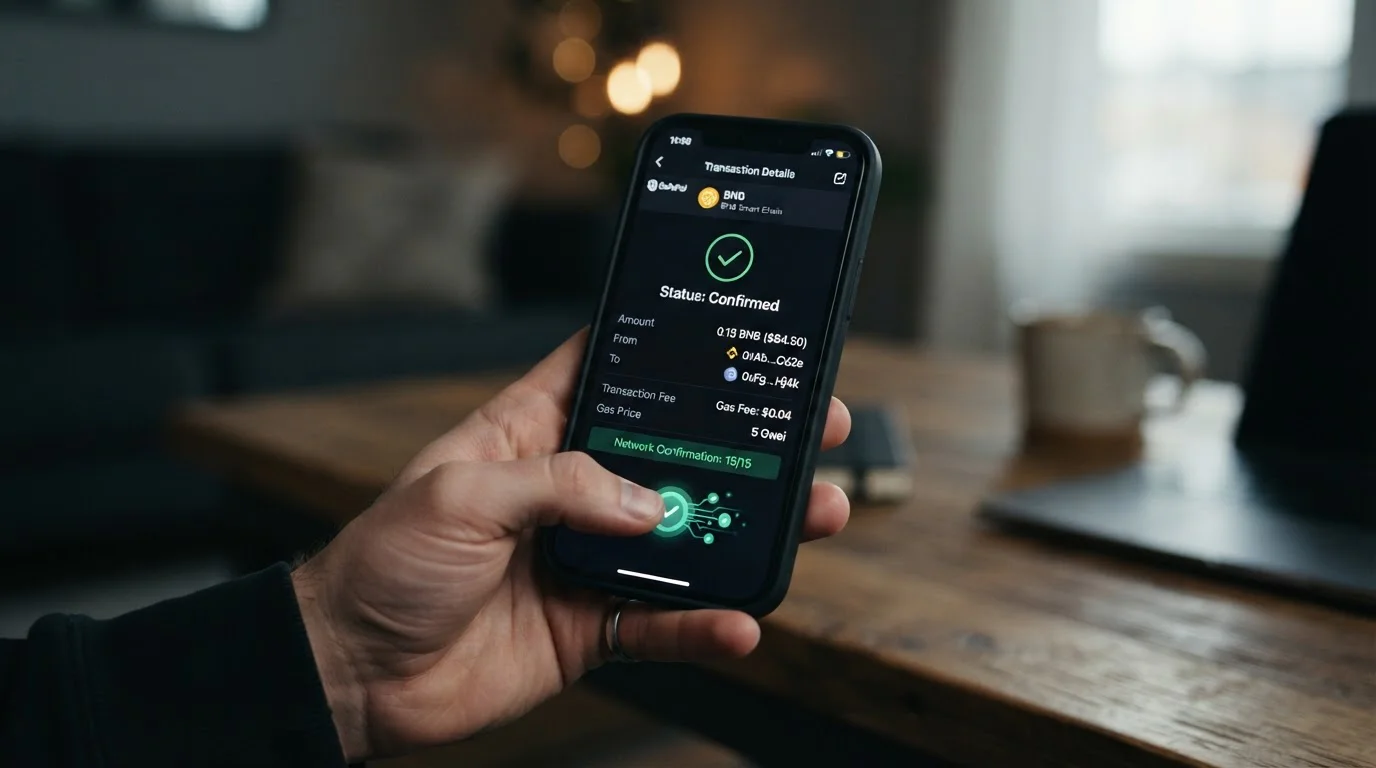
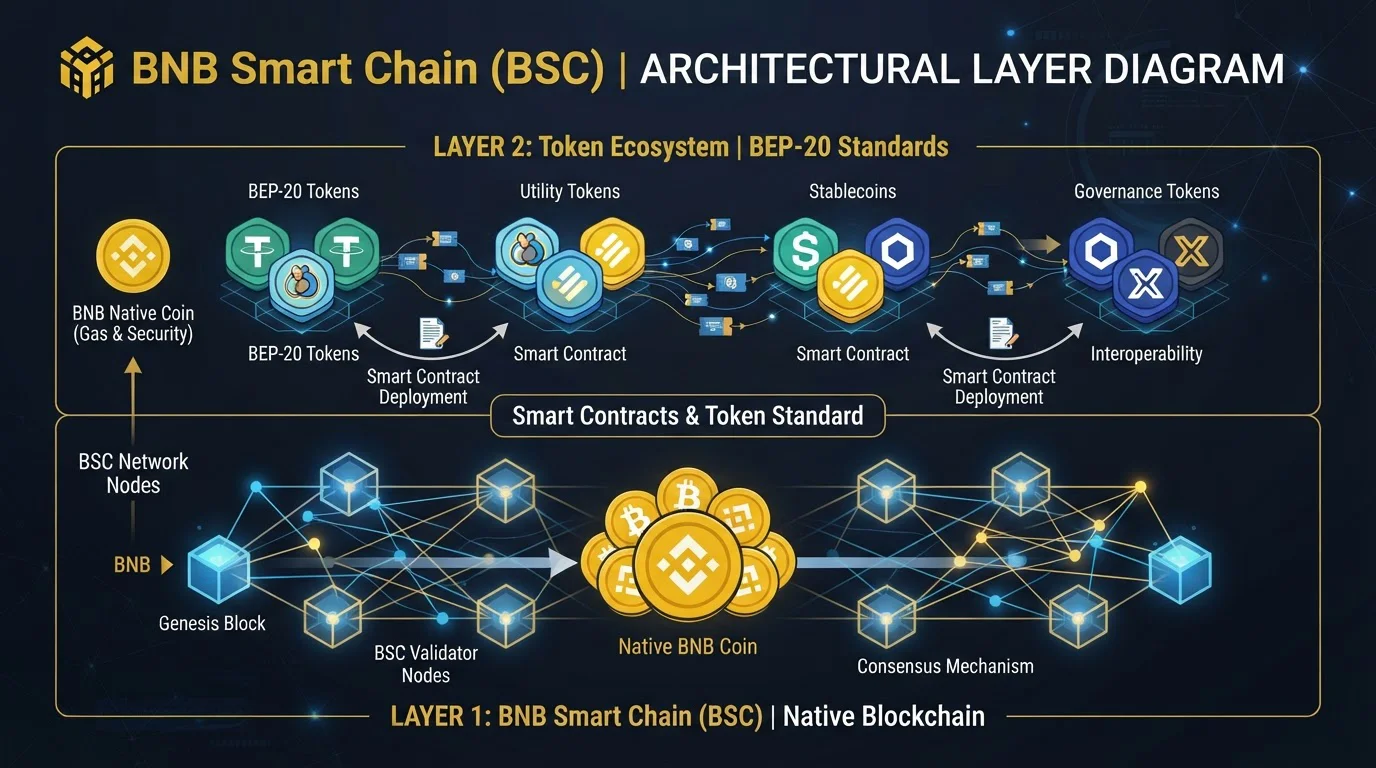
BNB is the native gas token of BNB Smart Chain, the blockchain that processes transactions when you send Binance Coin from one wallet to another. The chain runs on a proof-of-stake model, settles blocks every 0.45 seconds (down from 0.75 seconds before the January 2026 Fermi hard fork), and charges around 0.05 gwei as the minimum gas price. In pound terms, that translates to three to ten pence per transfer, sometimes lower when the chain is quiet.
When you deposit BNB to a casino, you are sending it over BNB Smart Chain using the BEP-20 token standard. BEP-20 is to BNB Smart Chain what ERC-20 is to Ethereum—a technical standard that defines how tokens behave on the network. Native BNB itself is not a BEP-20 token; it is the gas that powers the chain. But wallets and casinos often lump “BNB” and “BEP-20 tokens on BSC” into one category, because they move over the same network.
Here is where the confusion starts: many casinos that advertise “BNB accepted” do not hold BNB in your casino balance. They take your deposit, convert it to USDT-BEP20 (Tether on BNB Smart Chain) or their own house stablecoin at the moment it lands, and credit your account in that stablecoin. You deposited BNB, but your balance shows USDT. You are gambling in USDT. When you withdraw, you get USDT back, not BNB. The conversion is automatic, usually at market rate, and the terms rarely highlight it.
A smaller number of casinos—BC.Game, Stake, TrustDice—hold your BNB as BNB in your account. You deposit Binance Coin, your balance shows Binance Coin, you gamble in Binance Coin, and you withdraw Binance Coin. These are “true BNB-balance casinos.” The distinction matters if you care about holding BNB specifically (perhaps you expect the price to rise, or you want to avoid stablecoin exposure). If the casino auto-converts your deposit, you lose any BNB price appreciation while your funds sit in the account.
The network-fee advantage over Ethereum is stark. Ethereum gas fees during normal activity sit between £10 and £40 per transaction, spiking to £100-plus when the network is congested. BNB Smart Chain fees have not exceeded 50 pence in normal conditions for over a year. Bitcoin fees sit in between: £1 to £5 per transaction depending on mempool congestion and how fast you need the transfer confirmed. If you are moving small amounts—£50, £100, £200—Ethereum fees eat a meaningful chunk. BNB fees do not.
Confirmation times also favour BNB. Most casinos require 15 network confirmations before crediting a BNB deposit. At 0.45 seconds per block, those 15 confirmations take under seven seconds; add the casino’s own crediting step and most deposits land well inside a minute of broadcast. Bitcoin deposits require anywhere from 1 to 6 confirmations depending on the operator, translating to 10 to 60 minutes. Ethereum deposits at 12-second block times and 12 confirmations land in about two and a half minutes. BNB is the fastest of the three major deposit coins, and it is also the cheapest.
The catch is liquidity. BNB is less widely held than Bitcoin or Ethereum, so if you do not already own Binance Coin, you will need to buy it or swap another crypto for it before depositing. Most UK players use Binance itself, Coinbase, or Kraken to fund a BNB balance, then transfer to the casino. Binance lets you buy BNB with a debit card (though UK banks increasingly block gambling-related crypto purchases), and peer-to-peer markets offer another route if card purchases fail.
What’s the difference between BNB and BEP-20 tokens at casinos?
BNB is the gas token of BNB Smart Chain; BEP-20 is a token standard for assets like USDT on that network. When a casino says “we accept BNB,” it usually means anything sent over BNB Smart Chain. Some auto-convert your BNB to a BEP-20 stablecoin, so your balance is held in USDT, not BNB.
What You Trade Off: UKGC Protection vs Offshore Speed
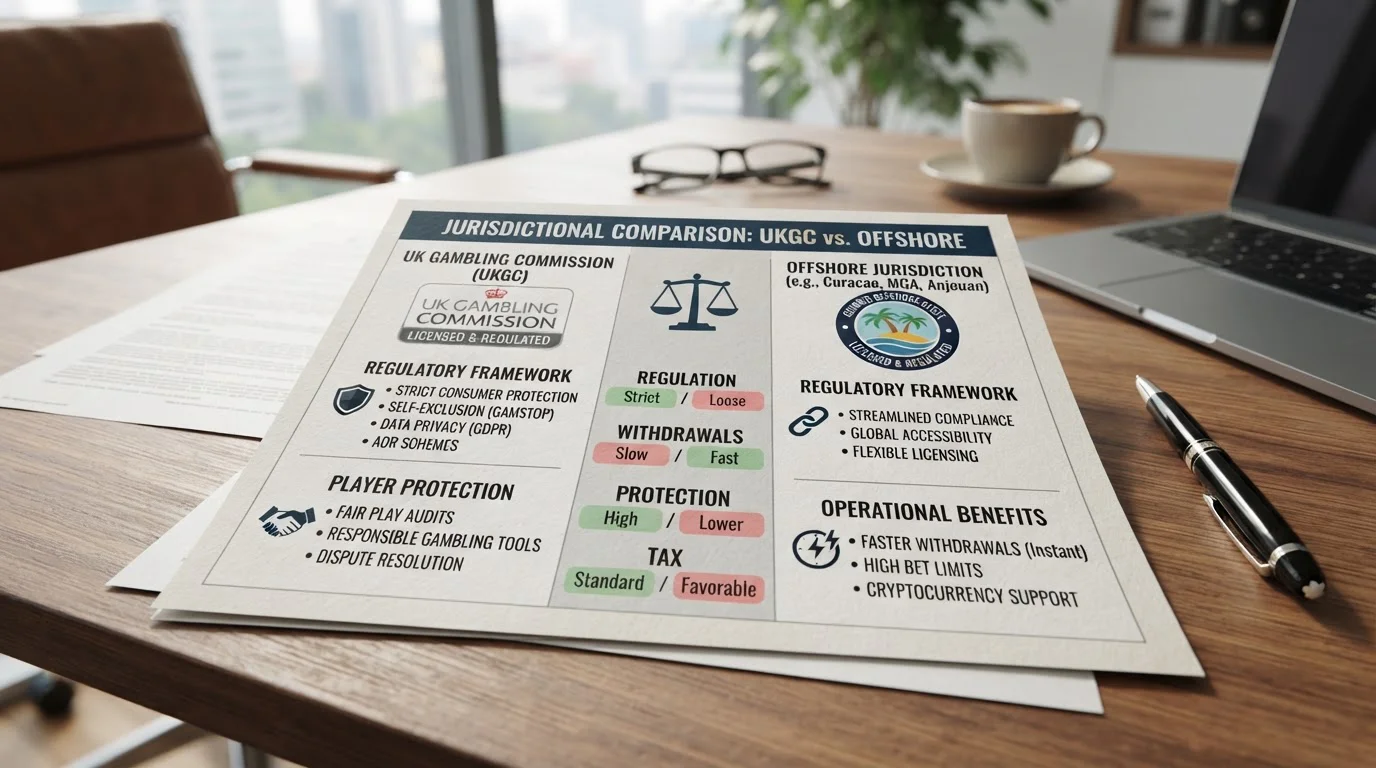
The table below is the decision in one page. UKGC-licensed casinos do not accept cryptocurrency, so the comparison is fiat UKGC sites against offshore BNB casinos. Every row is a tradeoff: you gain something, you lose something. There is no free win.
| UKGC-Licensed Sites | Offshore BNB Casinos | |
|---|---|---|
| Deposit limits | Deposit-limit tools must be offered; affordability checks apply | None (operator-set, not statutory) |
| GAMSTOP integration | Mandatory—if you self-exclude, you are locked out | Not connected—GAMSTOP does not cover offshore operators |
| Withdrawal caps | Operator-set, but often £5,000–£10,000/day | Operator-set, often higher or none (see BC.Game exception) |
| ADR route | Independent—IBAS, eCOGRA, disputes can escalate outside operator control | Operator’s own process—rarely independent, no UK ADR |
| Funds protection | Operator must disclose its protection level (not protected, medium or high) | No disclosure requirement—operator holds your crypto |
| Complaint escalation | Operator’s process, then approved ADR; UKGC can fine or revoke licences | No UK jurisdiction—only licensing authority (if it exists) can act |
The UKGC protections are not theoretical. A UK-licensed casino must tell you, before you deposit, how well your balance is protected if it fails (not protected, medium or high). When a dispute escalates to an approved ADR provider such as IBAS or eCOGRA, the operator is bound by the adjudicator’s decision, and failure to comply can cost the licence. The UKGC does not resolve individual complaints, but it fines operators for breaches and has revoked licences for serious misconduct. None of that exists at an offshore BNB casino. If the operator decides your withdrawal breaches terms, your recourse is the operator’s own complaints process. If that process exhausts and you are still dissatisfied, there is no external escalation.
GAMSTOP is the clearest example of the tradeoff. A UK player who self-excludes through GAMSTOP is locked out of every UKGC-licensed operator for the duration they chose—six months, one year or five years. Offshore casinos are not connected to GAMSTOP, so nothing stops an excluded player registering at an offshore platform—and that is a serious gap, not a feature. If you self-excluded, the exclusion exists for a reason: an offshore site removes the block without adding any UK protection in its place. If you are tempted to play while excluded, talk to GamCare on 0808 8020 133 or use the tools at BeGambleAware before you deposit anywhere.
Deposit limits at UKGC sites exist, and they bind. Operators must offer deposit-limit tools, run affordability checks as spending rises, and cap online slot stakes at £5 per spin (£2 for 18–24-year-olds) since 2025. Once set, the limit cannot be raised for 24 hours (a cooling-off rule designed to prevent impulsive increases). Offshore casinos have no statutory deposit limits. Some impose their own caps for risk management, but those caps are higher and more flexible. A player who wants to deposit £2,000 in a weekend will hit friction at a UKGC site and sail through at Stake or Cloudbet.
Withdrawal speeds offshore are genuinely faster. UKGC sites process payouts in hours to days, with bank transfers taking one to five business days to land. Offshore BNB casinos clear crypto withdrawals in minutes. Bitcasino averages two minutes from request to blockchain confirmation. TrustDice and Rollbit deliver withdrawals in seconds when the platform is running smoothly. The speed is real, and it is the strongest practical advantage of offshore operators. The question is whether that speed is worth giving up funds-protection disclosure and independent ADR.
The licensing asymmetry compounds the risk. A UKGC licence is public, audited, and revocable. An Anjouan licence is issued by a jurisdiction with limited transparency, no public register, and minimal oversight. A Curaçao licence post-LOK reform (December 2024 onward) is stronger than the old master-licence system, but it is still one tier below MGA or UKGC in terms of player protection. Unlicensed operators—like mBit if its Curaçao claim does not verify—answer to no regulator at all.
What player protections do I lose by using an offshore BNB casino instead of a UKGC site?
You lose funds-protection disclosure (no obligation to say whether your balance is recoverable if the operator fails), independent ADR, GAMSTOP integration (self-exclusion does not carry over), statutory responsible-gambling limits, and licence accountability (offshore regulators lack the UKGC’s enforcement powers). What you gain is faster crypto withdrawals—nothing that replaces the protections listed here.
Can I legally use a BNB casino from the UK?
Yes—no UK law criminalises the player. Section 33 of the Gambling Act 2005 targets the operator, not the customer: offering gambling to GB residents without a UKGC licence is the platform’s offence. The practical risk is the absence of UK consumer protection, with the operator’s own complaints process your only route.
Games, Bonuses and Provably Fair Mechanics
Game libraries at these seven operators range from 2,500 titles (mBit) to ten thousand-plus (BC.Game, though that figure includes rebranded variations other casinos count as one slot). Stake sits at 3,000, supplied by 73 studios including Pragmatic Play, Evolution, NetEnt, Hacksaw Gaming, and BGaming. Bitcasino lists 5,000 games with 150 live dealer tables. TrustDice and Cloudbet both land around 2,500 to 3,000 depending on how you count regional variations. All seven offer slots, live casino, table games, and at least one sportsbook or esports section. The game-selection differences matter less than the withdrawal terms and licensing.
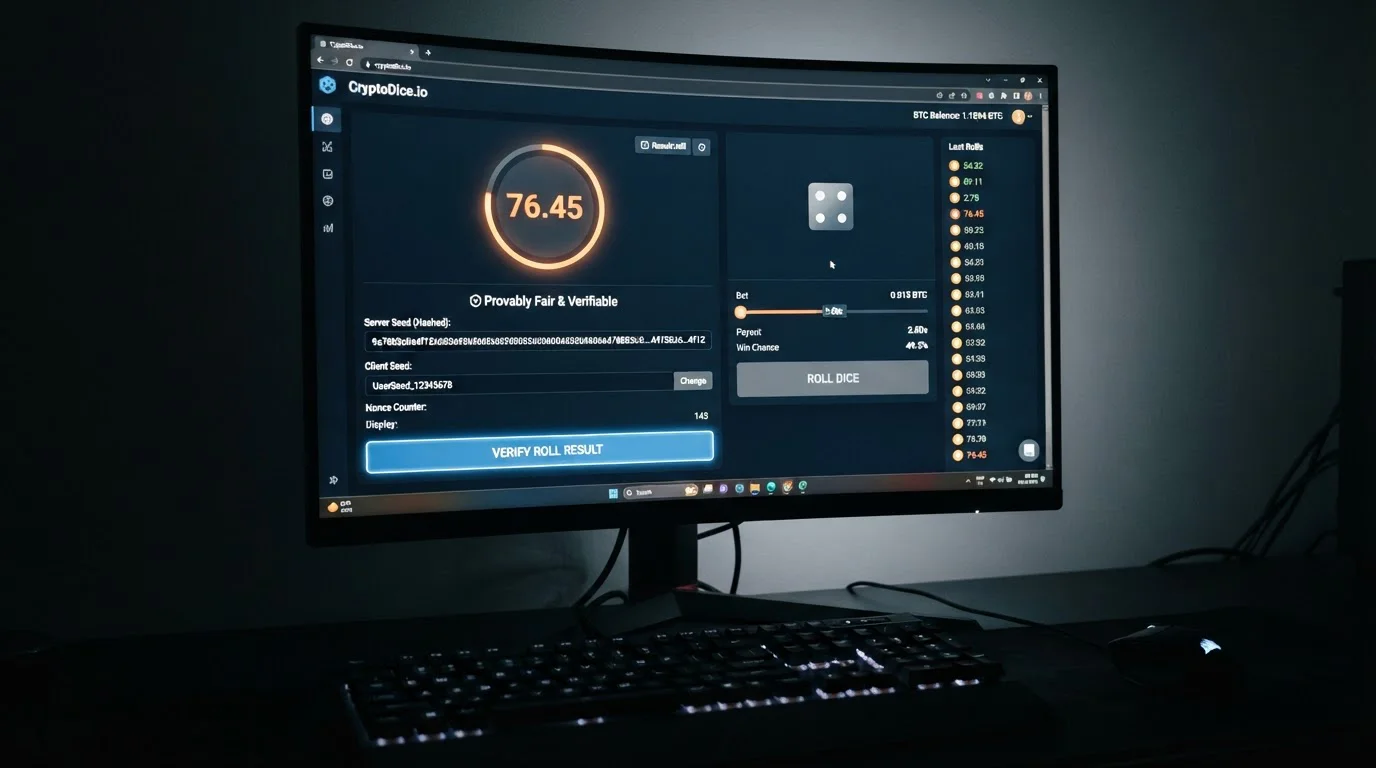
Provably fair games are the one innovation crypto casinos brought to the gambling sector that traditional operators have not matched. The mechanic is simple: the casino generates a server seed (a random string) and publishes a hashed version before the bet. You, the player, provide a client seed (another random string). The game combines server seed, client seed, and a nonce (a counter that increments with each bet) to generate the outcome. After the round, the casino reveals the server seed, and you can verify the result by running the same hash function yourself. If the revealed seed matches the hash published before your bet, the outcome was not manipulated after you wagered.
Studios like BGaming and in-house teams at Stake, BC.Game, and TrustDice use provably fair mechanics on their Dice, Plinko, Mines, Crash, and Limbo games. Traditional slots from NetEnt, Pragmatic, or Hacksaw are *not* provably fair—they run on standard RNGs audited by third parties like eCOGRA or iTech Labs, the same RNGs that power slots at UKGC-licensed casinos. The difference is transparency: a provably fair game publishes the seeds before the outcome, so you can verify it yourself. An RNG slot relies on an external auditor’s report that the RNG is fair, but you cannot verify individual spins.
Does provably fair matter? Only if you care enough to run the verification. Most players do not. The mechanic is there if you want it, and it does prevent the casino from altering an outcome after you bet, but it does not change the house edge. A provably fair Dice game at 1 percent house edge still loses money over time, just more slowly than an RNG slot at 4 percent house edge—the slot pays worse because the edge is higher, not because it is less fair.
Bonus structures across these platforms lean toward wagering requirements between 30x and 50x. mBit’s 325 percent match up to four BTC sounds enormous until you calculate turnover: the four-BTC ceiling is the maximum bonus, roughly 120,000 dollars at the prices used above, and 40x wagering on that bonus is 4.8 million dollars in bets before you can withdraw. That is not realistic for a casual player. Cloudbet’s 10 percent house-edge cashback is more transparent—you know exactly what you are getting, and there is no wagering requirement because it pays in withdrawable cash.
Stake offers no welcome bonus at all, replacing it with rakeback and VIP tiers. The rakeback percentage depends on your VIP level, starting at around 5 percent for new accounts and scaling up as you wager more. A high-volume player will clear more value from Stake’s rakeback than from a one-time match bonus at a competing platform, but it takes months of play to reach the higher tiers. BC.Game’s 500 percent RakeBack spreads across four deposits and works similarly—better for regulars, less useful for one-time depositors.
The game-library size is not a reliable quality signal. BC.Game’s ten-thousand-game claim includes every variation of the same slot rebranded by the studio for different markets. Bitcasino’s five thousand is a more honest count, excluding duplicates. What matters more is whether the operator lists the RTPs. Bitcasino and mBit both display RTP on every slot thumbnail, following a model Bitcasino introduced in 2014. Stake does not publish RTPs in the lobby—you can find them in the game’s info panel, but you have to click through. BC.Game and Rollbit similarly bury RTP info. If you pick slots by RTP, Bitcasino and mBit make that easier.
Live casino is where the differentiation shows. Evolution supplies most of the live tables across all seven operators, so the game selection overlaps heavily. The difference is stream quality and stake ranges. Stake and BC.Game both offer high-roller tables with £10,000-plus max bets. Bitcasino runs exclusive Evolution tables with Bitcasino branding. Cloudbet and TrustDice use the standard Evolution catalogue with no exclusives. Rollbit’s live section is smaller but functional. mBit’s live offering is the weakest in this group—fewer tables, lower max stakes, and occasional stream lag reported in reviews.
What does “provably fair” mean at BNB casinos?
Provably fair lets you verify a game result was not altered after your bet. The casino publishes a hashed server seed beforehand; you add a client seed, and both combine with a nonce to produce the outcome. After the round the revealed seed must match that hash. It does not remove the house edge.
How to Verify a Curaçao Licence (And Why It Matters in 2026)
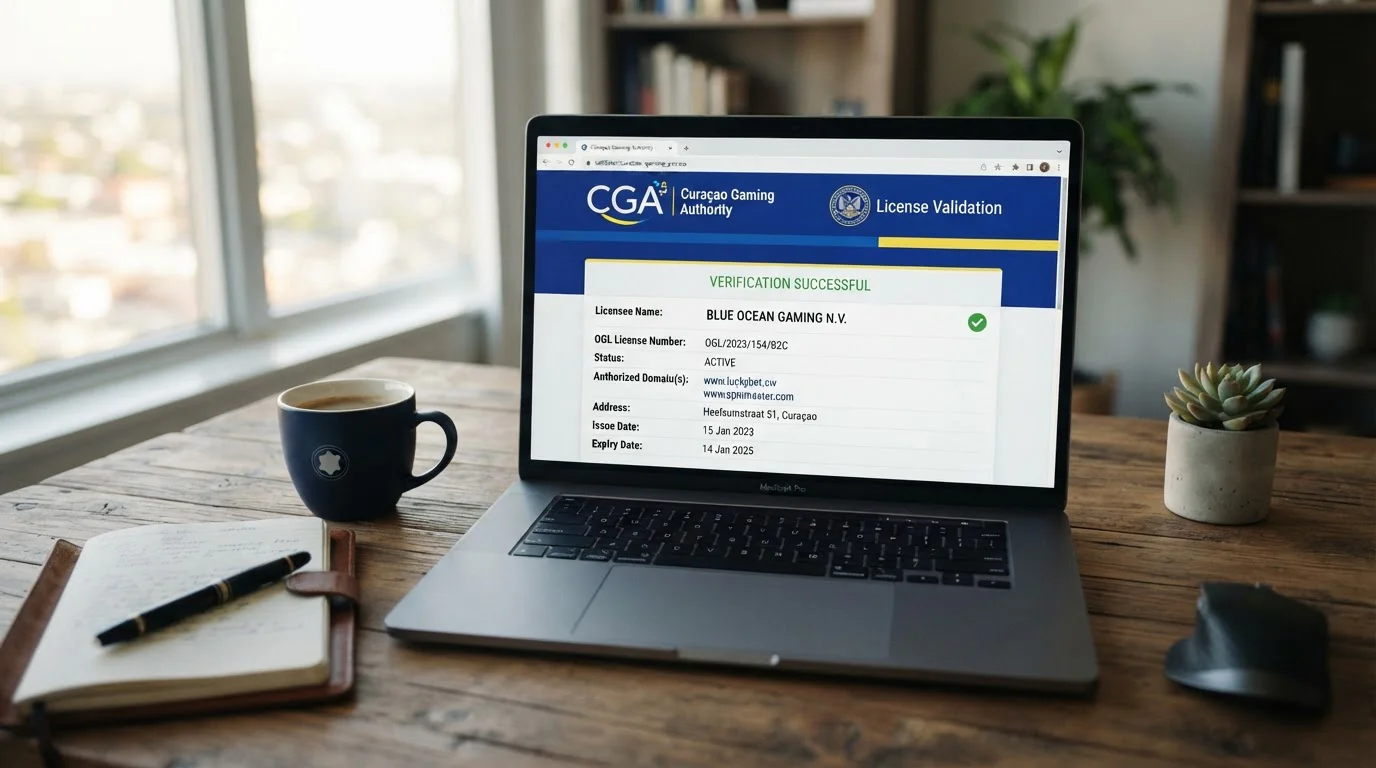
The Curaçao Gaming Authority reformed its licensing framework on 1 December 2024, replacing the old master-licence system with direct oversight under the Landsverordening op de Kansspelen (LOK). The old system allowed a handful of operators to hold master licences and sublicense to hundreds of platforms. The new system requires every operator to apply for its own licence directly from the CGA. Licences issued directly under the new regime carry the OGL prefix (e.g., OGL/2024/328/0599) and are verifiable on the new validator at validation.gaming-curacao.com.
To verify a licence: open the validator, enter the OGL number exactly as the casino displays it (copy-paste to avoid typos), and submit. The validator returns the licensee name, the licensed domain, the issue date, and the status. If the number does not return a match, either the casino mistyped its own licence number (possible but rare), or the licence is fake. Pre-LOK licences from the old master-licence system will not appear on the new validator—they were issued under a different framework, and most expired or were not renewed when the LOK reform took effect.
Why this matters: a post-LOK Curaçao licence signals the operator underwent fresh vetting as of late 2024. The CGA’s standards under LOK are stricter than the old master-licence regime, with enhanced KYC and AML requirements and a clearer complaints framework. It is still not UKGC-level oversight—Curaçao does not require the funds-protection disclosure UK operators must give, does not mandate an approved independent ADR provider, and does not link to GAMSTOP—but it is a step above the old system and several steps above Anjouan.
TrustDice (OGL/2024/664/0280, issued 16 July 2024) and Cloudbet (OGL/2024/328/0599) both hold OGL-prefix licences that appear on the new validator. Stake’s licence (OGL/2024/1451/0918) is listed with “Assessment in progress” as of September 2026, suggesting it is transitioning to the LOK framework or under review. BC.Game migrated to Anjouan and no longer holds a Curaçao licence. Rollbit similarly moved to Anjouan. mBit claims a Curaçao licence but does not appear on the new validator, suggesting it holds a pre-LOK sublicence that was not renewed or no licence at all.
Anjouan licences carry lighter oversight. The Autonomous Island of Anjouan (part of the Union of the Comoros) issues gambling licences through a private entity, not a government gaming authority. There is no public register, no published dispute-resolution process, and no validator to check licence authenticity. When an operator says “licensed in Anjouan,” you are trusting the operator’s word. BC.Game and Rollbit both migrated from Curaçao to Anjouan after facing pressure—court claims in Curaçao for BC.Game, the Ukrainian asset freeze for Rollbit. The migration tells you the operators judged Anjouan’s lighter touch preferable to Curaçao’s new scrutiny.
The practical impact for a UK player: a post-LOK Curaçao licence is verifiable, carries some baseline standards, and signals the operator passed fresh vetting in late 2024. A pre-LOK Curaçao licence or an Anjouan licence offers less assurance. An unlicensed operator (mBit’s status is unclear) has no regulator to answer to. If you are choosing between two platforms with similar products, pick the one with the verifiable licence. If the product at the unlicensed or Anjouan-licensed platform is meaningfully better (faster withdrawals, deeper game library, better terms), you are making a conscious tradeoff: better product, higher regulatory risk.
How do I verify a Curaçao casino licence is real?
Visit validation.gaming-curacao.com and enter the OGL number shown in the casino’s footer. The validator returns the licensee name, licensed domain, issue date and status for any valid post-LOK licence. Pre-LOK sublicences do not appear. If the number does not verify, the licence may be fake, expired or no longer renewed.
Tax, Legality and Practical Risks for UK Players
Gambling winnings in the UK are not taxable. The Betting and Gaming Duties Act 1981 places the tax burden on the operator, not the player. A £10,000 win at an offshore BNB casino is tax-free in your hands, just as a £10,000 win at a UKGC-licensed casino is tax-free. This applies whether the win is paid in BNB, Bitcoin, or GBP. The taxability of cryptocurrency itself is a separate question: if you hold BNB, and the price rises, and you sell or trade that BNB for another asset, HMRC treats the gain as subject to capital gains tax. The CGT annual exempt amount is currently £3,000. A casino win paid in BNB is a gambling win, not a CGT disposal, so it is not taxed.
The distinction matters if you deposit BNB you bought at a lower price, gamble, win, and withdraw more BNB than you started with. The gambling win itself (the increase from your deposit to your withdrawal) is not taxable. But if you later sell that BNB at a profit relative to what you originally paid for it, the *sale* triggers CGT. You are responsible for reporting that gain, whichever exchange or wallet you use. Keep a simple record of what you paid for each batch of BNB, what you deposited and withdrew, and what you sold it for; that record is what HMRC expects you to work from, and it makes the calculation straightforward if you ever need to file.
No UK player has been prosecuted under Section 33 of the Gambling Act 2005 for using an offshore casino. Section 33 criminalises the operator—offering gambling to GB residents without a UKGC licence—not the player. The offence sits with the platform. The UKGC and UK police have never pursued individual players, and there is no indication that policy will change. The enforcement focus is on unlicensed operators advertising to UK audiences, not on players who navigate to offshore sites.
The practical risks for you as a player are different. If the operator decides your account breaches terms—multi-accounting, bonus abuse, arbitrage betting, or vague “irregular play patterns”—your funds can be confiscated and your account closed. Offshore operators reserve this power in their terms, and there is no independent review process. At a UKGC site, you can escalate to IBAS or eCOGRA. At an offshore BNB casino, you can email support, post on forums, and hope public pressure moves the operator. Often it does not.
Payment-processor blocks are rare but increasing. Some UK banks flag crypto purchases to gambling-linked exchanges and decline the transaction. Barclays, NatWest, and Lloyds have all implemented restrictions on crypto purchases in recent years, citing fraud and AML concerns. If you have switched on a gambling block with your bank, treat it as a decision to respect rather than an obstacle to route around; moving money through crypto to reach a casino defeats the point of the block. If a block is triggering on legitimate exchange purchases, speak to your bank directly about it.
Access blocks are another friction point. Some UK ISPs and filtering tools restrict access to offshore gambling domains. A block is a signal about the site, not a puzzle to solve: using a VPN to get around it adds no protection, and casino terms commonly restrict access from certain jurisdictions or treat VPN detection as grounds to void winnings. TrustDice’s terms do not ban VPN use outright; Stake’s and BC.Game’s are less clear. Either way, a payout dispute over location is one you have no UK route to resolve.
The risk-reward balance is personal. If you are comfortable with the absence of UK consumer protection, willing to accept that disputes are resolved by the operator’s own process, and value the faster withdrawals and higher limits offshore casinos offer, BNB platforms are a functional route. If you want the backstop of funds-protection disclosure, GAMSTOP and independent ADR, you are locked into UKGC-licensed casinos, and that means no crypto deposits. There is no middle ground. The UKGC will not license crypto-accepting operators, and offshore operators will not subject themselves to UKGC oversight.
Do I need to pay tax on BNB casino winnings in the UK?
No. Gambling winnings are not taxable in the UK; a win paid in BNB, Bitcoin or GBP is tax-free. However, if you later sell that BNB at a profit relative to what you paid for it, the sale may trigger capital gains tax. The CGT annual exempt amount is currently £3,000.
Crypto Casinos UK 2026 — Bitcoin Cash, Solana, XRP and More
Content created by the «casinopayoptions-uk.com» team