
Best No-KYC Crypto Casinos for UK Players 2026: Offshore Platforms Compared
 Available in GB
The UK Gambling Commission tightened the screws in 2025. Financial risk checks now apply from £150 in net monthly deposits, operators must verify your age and identity before you can gamble, and every licensed operator must check GamStop before you stake a penny. Add the absence of any direct cryptocurrency deposit option at UKGC-licensed sites, and you have the regulatory context that drove thousands of British players offshore.
A no-KYC crypto casino is an offshore platform—typically licensed in Curaçao or Anjouan—that lets you register with an email address, deposit Bitcoin or Ethereum straight from your wallet, and withdraw without uploading a passport or utility bill. The trade-off is explicit: you gain speed, anonymity, and access to crypto rails. You lose GamStop protection, UK-approved dispute resolution, and the funds-protection disclosure UKGC operators must give you.
This is not a theoretical exercise. Nine offshore crypto casinos below accept UK players in 2026, process crypto payouts in minutes to hours, and defer identity verification to withdrawal thresholds that range from explicit (Jackbit at $5,000 cumulative, mBit at 1 BTC) to vague (BC.Game “on big wins”). The regulatory impossibility is structural: no UKGC-licensed operator can offer this, full stop. If you want no-KYC crypto play, you are choosing an offshore site, with everything that entails.
What follows is not a sales pitch. It is a map of where the no-KYC crypto casino market stands for UK players in 2026, which platforms deliver on their claims, and what the fine print actually says about verification. Read the terms before you deposit, test a small withdrawal first, and understand that offshore means exactly that—outside UK jurisdiction, outside UK consumer law, outside the reach of UK-approved ADR providers such as IBAS if things go wrong.
What does “no KYC” actually mean—will I never need to verify my identity?
No KYC means no identity documents at registration and none for ordinary play. Most offshore crypto casinos defer KYC to a withdrawal threshold—commonly €2,000 to €10,000—or trigger it when you win large or trip an anti-fraud flag. A few process every payout without asking, but their terms still reserve the right to verify.
Nine Offshore Crypto Casinos Compared
The table below compares nine offshore platforms that accept UK players without upfront KYC, ordered by operational track record and feature set. Every entry holds a Curaçao or Anjouan licence, processes crypto deposits and withdrawals, and defers or skips identity verification up to defined thresholds. Withdrawal speeds are operator-stated or independently tested ranges; KYC thresholds come from the terms as published in September 2026.
| Casino | Licence | KYC Threshold | Withdrawal Speed | Key Feature |
|---|---|---|---|---|
| Stake | Curaçao OGL/2024/1451/0918 | Undefined large amounts | Instant to 24h | No withdrawal cap, VIP rakeback |
| BC.Game | Anjouan | On “big wins” (undefined) | ~4 minutes tested | Provably fair Originals, fast automated payouts |
| Cloudbet | Curaçao OGL/2024/328/0599 | Post-verification unlimited | Typically <24h | Oldest brand (2013), independent adjudicator |
| Rollbit | Curaçao/Anjouan | Risk-based | Instant | 1000x crypto futures, NFT marketplace |
| Jackbit | Curaçao | $5,000 cumulative | <1 hour | 30% rakeback, sportsbook-first |
| Bitcasino.io | Curaçao OGL/2023/111/0069 | Risk-based | ~2 minutes | Since 2014, Yolo Group |
| 7Bit Casino | Curaçao/Tobique | Risk-based | Instant (15 cryptos) | 10,000+ games, hybrid crypto-fiat |
| FortuneJack | Anjouan ALSI-202411021-FI1 | Risk-based | Instant | Altcoin-friendly, provably fair |
| mBit Casino | Curaçao | 1 BTC cumulative | ~10 minutes | RTP shown on slot thumbnails |
Are no-KYC crypto casinos legal for UK players in 2026?
Playing at an offshore crypto casino from the UK is not illegal for the player. UK law requires any operator serving British residents to hold a UKGC licence, so the offence sits with the operator. But you forfeit every UKGC protection: GamStop self-exclusion, access to a UK-approved ADR provider such as IBAS, and funds-protection disclosure.
Stake — No Withdrawal Ceiling, VIP Rakeback Focus
Stake operates at the top end of offshore crypto casinos, pulling in high-volume players with a VIP rakeback model instead of a traditional welcome bonus. Medium Rare N.V. runs the platform under Curaçao Gaming Authority licence OGL/2024/1451/0918, active since the 2024 LOK reform transitioned operators from the old master-licence system to direct CGA oversight. The register check in September 2026 showed “Assessment in progress,” and leaked CGA documents revealed the licence was granted before ownership verification of founders Ed Craven and Bijan Tehrani was complete—regulatory controversy that did not stop the licence remaining live.
The game library sits at 6,000+ titles from 73 studios, spanning slots, live casino, table games, and Stake Originals (in-house provably fair games). The sportsbook runs parallel, settling on the same crypto wallet. Stake supports 20+ cryptocurrencies including Bitcoin, Ethereum, Litecoin, Dogecoin, XRP, and USDT across multiple networks. Withdrawal processing ranges from instant (for automated small amounts) to 24 hours (manual review queue for large sums), with no stated cap once you clear verification. KYC is deferred but undefined—terms say it may be required for “large withdrawals” without specifying a threshold, so assume it can land at any time.
Stake targets experienced crypto players and high-rollers. The VIP programme pays rakeback on total wagering rather than locking funds behind playthrough requirements, a model that suits volume players over casual depositors. If you want a household-name offshore brand with deep liquidity and no withdrawal ceiling, Stake delivers. If you want a clear no-KYC threshold stated upfront, it does not.
BC.Game — Provably Fair Originals and Fast Payouts
BC.Game entered the crypto casino market in 2017 under Twocent Technology Limited, now operating on an Anjouan Gaming licence after roughly nine years in the field. Anjouan licensing sits at the lighter end of offshore oversight—less stringent than post-LOK Curaçao, with minimal KYC enforcement at regulator level—which positions BC.Game as one of the more permissive platforms for pseudonymous play. Independent 2026 testing clocked average payouts at around four minutes from request to blockchain confirmation, among the fastest in this comparison.
The platform integrates casino, sportsbook, and a native BCD token ecosystem with a yield vault for staking. Provably fair Originals sit prominently in the game lobby, each publishing server seed, client seed, and nonce for per-bet verification. Evolution Gaming and Pragmatic Play supply the live casino. The gamification layer—quests, missions, level progression—wraps around a library that runs into the thousands of titles, though exact counts are not published. Its terms are relatively relaxed about VPN use, which is no reason to use one: a VPN adds no player protection and can be cited in a payout dispute.
KYC triggers on “big wins” per the terms, an algorithmic threshold the platform does not define in advance. Trustpilot and neutral mediator cases document disputes where players winning four-figure or five-figure amounts faced sudden verification requests and payout holds. For modest play (sub-€1,000 withdrawals), BC.Game processes without asking. For anything larger, assume verification can land. The light-touch verification makes it popular with privacy-focused players; the undefined KYC trigger makes it a gamble if you hit a big multiplier.
Cloudbet — Oldest Brand with Independent Adjudicator
Cloudbet launched in 2013, making it the longest-running name in this comparison and one of the original Bitcoin casino brands. Thirteen years operational, now under Curaçao Gaming Authority licence OGL/2024/328/0599, gives it the deepest track record in the offshore crypto space. The platform combines casino, sportsbook, and esports under a single wallet that supports 29 cryptocurrencies—the widest coin selection in this set, spanning Bitcoin, Ethereum, Litecoin, USDT (TRC20 and ERC20), Dogecoin, Monero, Solana, Cardano, and multiple Layer 2 options.
Twenty-three provably fair Originals publish their RTP percentages and seed data for verification. The sportsbook features Bet Builder, a Pulse social feed for community bets, and Whale Mode for high-stake punters. The casino pulls from the standard studio roster—Pragmatic Play, Evolution, NetEnt, Play’n GO—with no standout exclusives beyond the Originals. The 30-day welcome calendar pays up to $2,500 in cash (no wagering on the cash component), structured as a rewards calendar rather than a lump deposit match.
What sets Cloudbet apart is dispute resolution: the terms name an independent adjudicator whose decisions are binding on the casino, a feature no other operator in this comparison provides. UK players forfeit access to UK-approved ADR providers such as IBAS, but Cloudbet at least offers a formal escalation path. Withdrawal processing runs typically within 24 hours per the stated terms, with no cap once you complete full KYC. The catch: Cloudbet requires verification before removing withdrawal limits, so the platform is less “no-KYC” and more “soft-KYC with unlimited payouts post-verification.” For players willing to verify upfront in exchange for a binding adjudicator and established brand, it works. For those chasing unconditional anonymity, it does not.
Rollbit — Instant Withdrawals and 1000x Crypto Futures
Rollbit is more than a casino. It is a casino, sportsbook, esports betting platform, NFT marketplace, and 1000x-leverage crypto futures desk running on a single wallet under Bull Gaming N.V., licensed in both Curaçao and Anjouan. The offshore version at rollbit.com is distinct from the UKGC-licensed Rollbit UK (verify on the public register at gamblingcommission.gov.uk), which operates without crypto and under full KYC/AML. If you access rollbit.com from the UK, you are on the offshore entity, outside Commission jurisdiction.
The casino library sits at 4,000+ games. The sportsbook covers mainstream and niche markets. The futures desk offers synthetic crypto contracts with up to 1000x leverage, a feature that attracts degen traders as much as gamblers. The NFT marketplace sells Rollbot lootboxes, which tie into the platform’s RLB token economy. The token itself funds a lottery pool drawn from casino revenue, pays staking rewards, and underpins the 5% rakeback programme—no wagering requirement, cash back on every bet regardless of outcome.
Instant withdrawals are Rollbit’s flagship claim, and multiple 2026 tests confirm it delivers. Automated crypto payouts clear in under a minute for amounts below internal thresholds; larger sums enter a manual queue but still process within an hour in most reports. There is no welcome bonus. The value proposition is the 5% unwagered rakeback, the instant cashouts, and the multi-product platform for users who want casino, sports, and crypto trading under one account. KYC is risk-based and undefined. For ordinary play, Rollbit does not ask. For large wins, bonus abuse patterns, or IP mismatches, it can.
Jackbit (Jack) — Sportsbook-First with 30% Rakeback
Jackbit rebranded to Jack in 2026 after launching in 2022 under Data Link Digital B.V., a Curaçao-licensed operator. The architecture is sportsbook-first: sports betting sits at the core, the casino is a secondary offering, the opposite of most crypto casinos which bolt on a sportsbook as an afterthought. A UKGC register check in July 2026 showed no UK licence for Jack, Jackbit, or Data Link Digital B.V.—offshore only.
The game library lists 5,000+ titles. The sportsbook covers football, tennis, basketball, esports, and niche markets with competitive odds and in-play betting. The crypto infrastructure treats Bitcoin, Ethereum, and Litecoin as primary rails rather than payment add-ons, enabling sub-hour payouts on crypto withdrawals per the marketing claim. Independent September 2026 testing confirmed 100 free spins with no wagering requirement on sign-up, an unusual structure in an industry where “free” spins carry 35x-40x playthrough.
Thirty per cent rakeback from day one is the highest headline rakeback figure in this comparison, but it is not directly comparable with Rollbit’s 5% on all bets: Jack structures its 30% differently, and it may be tiered or carry conditions, so read the rakeback terms before you rely on the headline. KYC threshold is explicit: $5,000 cumulative withdrawals trigger Sumsub AI verification. Below that, you play and cash out without documents. Above it, the system requests ID, proof of address, and a selfie holding your ID. The $5,000 figure is higher than most competitors, making Jack one of the more permissive platforms for no-KYC play up to mid-four-figure bankrolls. For sportsbook-focused players who want crypto rails and a clear verification line, Jack is the pick. For casino purists, the sports-first design may feel backwards.
Bitcasino.io — 2-Minute Payouts Since 2014
Bitcasino.io launched in 2014 under Moon Technologies B.V., part of the Yolo Group multi-brand operation that includes Sportsbet.io and Livecasino.io. The Curaçao Gaming Authority licence OGL/2023/111/0069 replaced the pre-LOK licence 1668/JAZ when the December 2024 reform transitioned operators to direct CGA oversight. Twelve years operational gives Bitcasino a heritage claim, though age alone does not guarantee trust—Trustpilot shows a 2.1 rating with recurring KYC loop complaints from players who won and then faced verification delays.
The game library runs to 5,000+ titles shared across the Yolo Group brands, with 150+ live casino tables from Evolution and Pragmatic Live. Slots dominate the lobby; table games and speciality offerings take a back seat. Average withdrawal processing clocked in at around two minutes in 2026 testing, among the fastest in this comparison. The crypto-only cashier accepts Bitcoin, Ethereum, Litecoin, USDT, and a handful of altcoins. Gamification features—missions, challenges, a loyalty ladder—wrap around the core casino offering, pushing engagement through streak bonuses and level unlocks.
The welcome package pays up to 5,000 USDT over three deposits, with wagering requirements in the standard 35x-40x range. Multiple reload and cashback offers run weekly. KYC is risk-based and not disclosed upfront. For small-stakes recreational play, Bitcasino processes without asking. For wins above a few hundred pounds sterling equivalent, verification requests appear. The Yolo Group pedigree and 2-minute processing are the draw. The KYC disputes and 2.1 Trustpilot rating are the warning.
7Bit Casino — 10,000+ Games, Hybrid Crypto-Fiat
7Bit Casino operates under Scores55 Tech B.V. with a Curaçao Gaming Authority licence, plus additional Tobique Gaming Commission and Estonia licences for regulatory coverage in specific jurisdictions. Operational since 2014, it runs a hybrid crypto-fiat model: you can deposit and withdraw in Bitcoin, Ethereum, Litecoin, USDT, and 11 other cryptocurrencies, or use credit cards and e-wallets if you prefer traditional rails. Most offshore crypto casinos are crypto-exclusive; 7Bit bridges both worlds.
The game library is the largest in this comparison at 10,000+ titles sourced from 100+ providers including NetEnt, Pragmatic Play, Play’n GO, Yggdrasil, Quickspin, and BGaming. The welcome package scales to 5.25 BTC for crypto deposits (the fiat version tops out at €1,500) across four deposits, structured as 325% total match plus 250 free spins. A 25% Monday reload bonus runs weekly. The VIP programme’s cashback drops to 1x wagering at level 12, industry-low for a cashback playthrough and a meaningful perk for high-volume players grinding the ladder.
Instant crypto withdrawals across 15 cryptocurrencies are marketed; independent tests confirm sub-30-minute processing for Bitcoin, Litecoin, and USDT TRC20. KYC is risk-based and undefined in the terms. Casino Guru awarded 7Bit a 9.1 Safety Index and a Fairest Terms & Conditions badge, rare recognition in the offshore space. Provably fair titles from BGaming publish seed data for verification. The hybrid model suits players who want crypto speed without abandoning fiat flexibility. The 10,000+ game library is overkill for most, but depth matters if you exhaust smaller catalogues.
FortuneJack — Altcoin-Friendly Provably Fair Play
FortuneJack has operated since 2014, initially under a Curaçao licence and now under PlayWave SRL (Costa Rican company) with Anjouan Gaming licence ALSI-202411021-FI1 issued in November 2024. The switch from Curaçao to Anjouan under new ownership signals regulatory arbitrage toward lighter oversight, a move that aligns with FortuneJack’s positioning as a permissive, altcoin-friendly platform.
Provably fair games anchor the offering: dice, crash, and other Originals publish server seed (hashed before the bet), client seed (player-supplied), and nonce (per-bet counter) so you can verify every outcome via hash recomputation. The verification tools are accessible, not buried—FortuneJack has leaned into provably fair as a transparency feature since its early days. Altcoin support runs deeper than most competitors; the cashier accepts niche cryptocurrencies beyond the Bitcoin-Ethereum-Litecoin standard, making it a draw for holders of smaller-cap coins.
The 110% first-deposit welcome bonus sits in the mid-range for crypto casino offers. Instant crypto payouts are marketed; real-world processing depends on network and amount. The reputation is mixed. Trustpilot removed FortuneJack’s rating after detecting fake reviews, and 61% of the remaining 182 reviews are one-star. Operator replies ceased in March 2026. Casino Guru and other neutral mediators still list it as operational with no systemic scam pattern, but the review situation and vanished support presence are red flags.
For players who want provably fair verification and altcoin diversity, FortuneJack delivers features competitors do not. For players who want a squeaky-clean reputation and responsive support, it does not. Test a small withdrawal before committing a bankroll.
mBit Casino — RTP Transparency and 1 BTC No-KYC Threshold
mBit Casino launched in 2014 under a Curaçao licence, positioning itself as a Bitcoin-first platform that later expanded to multi-cryptocurrency support. Twelve years operational gives it veteran status in a market where most brands fold or rebrand within five. The game library sits at 4,000+ titles. Instant Bitcoin withdrawals average around ten minutes from request to wallet confirmation in 2026 testing. The welcome package offers 110% first-deposit match plus 300 free spins, structured conventionally with 35x wagering on the bonus component.
What sets mBit apart is RTP transparency: every slot thumbnail displays its return-to-player percentage, and the library is sortable by RTP. This feature has been live since 2014, long before RTP disclosure became an industry talking point. If you want to grind high-RTP slots (98%+ games exist in the catalogue), mBit hands you the data upfront instead of making you hunt provider sheets.
KYC threshold is explicit: 1 BTC cumulative withdrawals. Below that, you play and cash out document-free. At or above 1 BTC total, the platform requests identity verification—passport or driving licence, proof of address, and a selfie holding your ID. The 1 BTC figure translates to roughly $60,000-$70,000 at current exchange rates, a generous threshold for recreational players but not enough for high-rollers. Large wins may be paid in instalments rather than lump sums; the terms state this explicitly. The terms also permit balance confiscation if you refuse or fail to complete KYC when requested, standard offshore language but worth flagging.
For players who want transparent RTP data, a clear no-KYC line, and a long operational history, mBit is the straightforward pick. For high-stakes players expecting unrestricted lump payouts, the instalment clause and 1 BTC verification threshold are deal-breakers.
How to Choose a No-KYC Crypto Casino: What to Check Before You Deposit
Offshore crypto casinos market themselves on speed and anonymity, but the gap between the landing page and the fine print determines whether you cash out in ten minutes or spend three days uploading documents. Five checks separate a tested platform from a ticking dispute.
Check the Licence and Regulator
Curaçao post-LOK (December 2024 forward) means direct Curaçao Gaming Authority oversight with published licence numbers verifiable on the CGA validator. Anjouan means lighter regulation and less enforcement muscle if a dispute lands. Costa Rica and unlicensed platforms offer no regulatory recourse at all. A Curaçao licence does not guarantee fair play, but it at least confirms the operator paid for legitimacy theatre. No licence at all means you are trusting a faceless entity with your crypto, and good luck getting it back if they ghost you.
Verify the KYC Threshold in the Terms
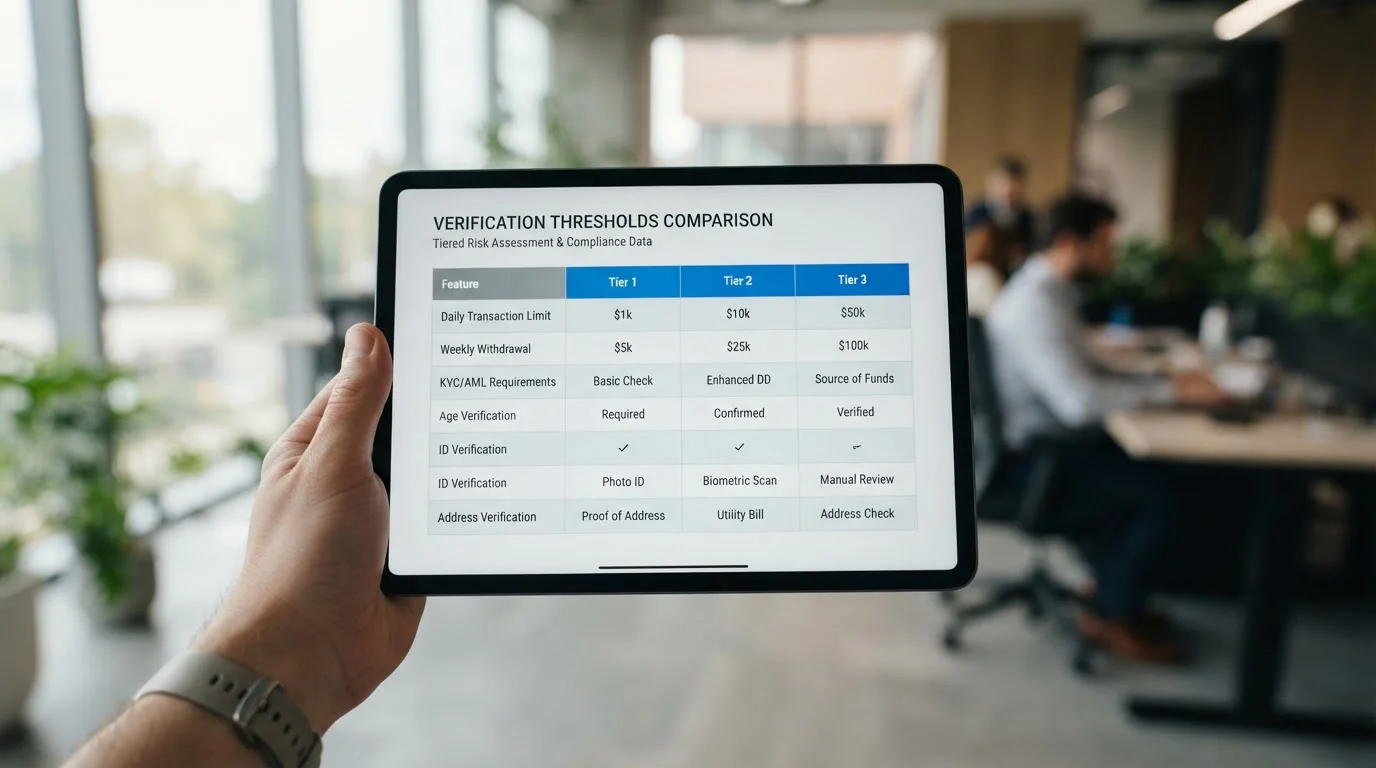
“No KYC” is marketing. The terms control reality. Open the Terms & Conditions, search for “KYC,” “verification,” “identity,” “AML,” and “compliance,” and read what triggers a document request. Jackbit states $5,000 cumulative. mBit states 1 BTC cumulative. BC.Game says “big wins” without defining the threshold. Stake and Rollbit reserve the right without specifying a figure. If the threshold is undefined, assume verification can land at any withdrawal amount, and the operator will decide case-by-case whether your payout is “suspicious” enough to warrant a hold.
Test Withdrawal Speed and Limits
Deposit £20 equivalent in Bitcoin, play a few spins, and withdraw £15. Time it from request submission to wallet arrival. A genuine instant-withdrawal casino clears this in under an hour. A platform that holds it for “manual review” or asks for documents on a £15 test is showing you its true KYC posture before you risk a real bankroll. Withdrawal limits matter too: some offshore sites cap daily or weekly cashouts even after verification. If you win £5,000 and the limit is £500 per week, you are drip-fed over ten weeks, during which the operator can invent reasons to freeze the account.
Confirm Cryptocurrency Support
Bitcoin is universal. Ethereum works everywhere. Beyond that, check which networks the casino supports and what the gas fees look like. USDT on Ethereum (ERC20) costs $5-$20 in gas during peak congestion. USDT on TRON (TRC20) costs pennies and confirms in under a minute. Lightning Network offers instant Bitcoin settlement with negligible fees but requires a Lightning-enabled wallet. If the casino lists “Ethereum” but does not specify which layer or sidechain, you may end up paying $15 to move $50.
Check for Provably Fair Games
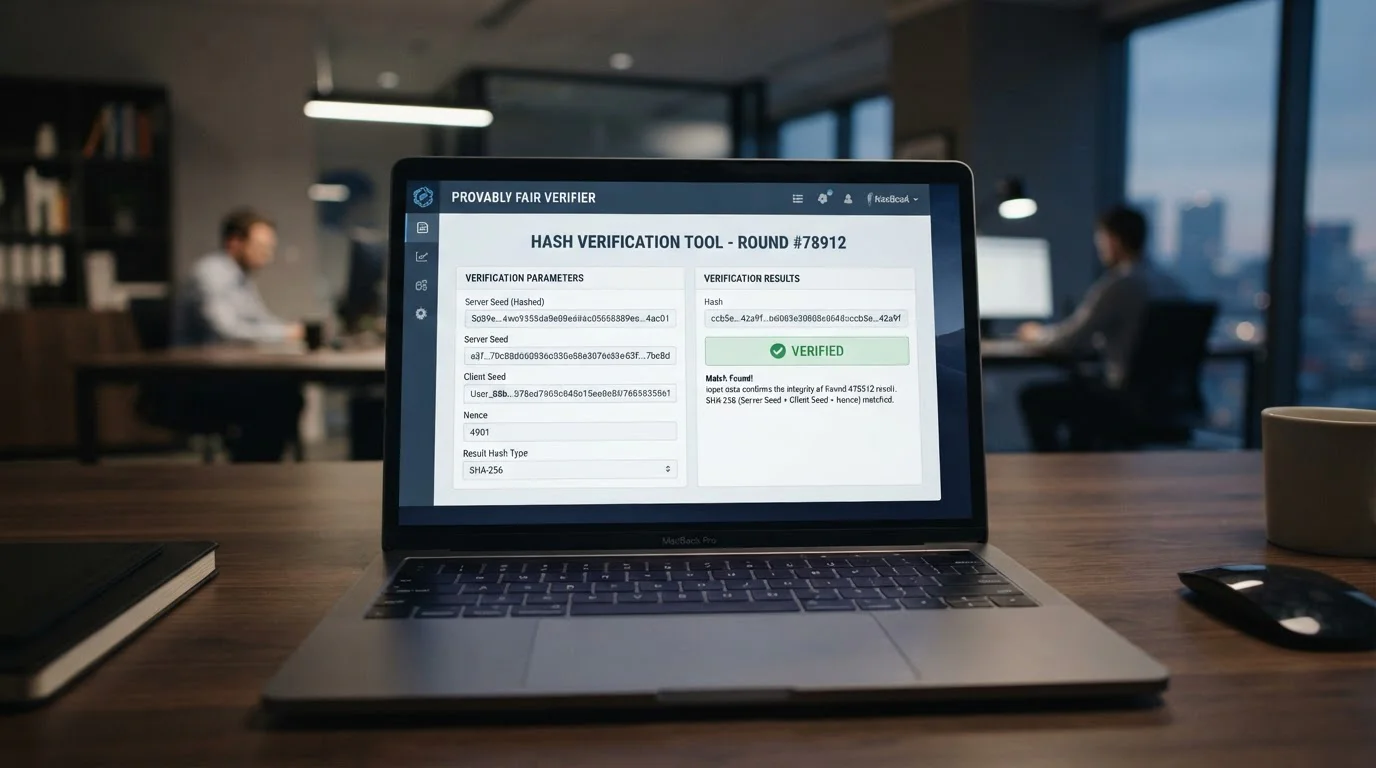
Provably fair means you can verify the outcome of each bet via cryptographic hashing, proving the casino did not manipulate the result after you placed your wager. The system works through three components: the server seed (casino’s random input, hashed and published before the bet), the client seed (your input), and the nonce (a per-bet counter). The game combines all three to generate the result. After the round, the casino reveals the server seed, and you recompute the hash to confirm it matches the pre-bet hash. If it does, the result is provably fair. If it does not, the casino cheated.
Not every game is provably fair. Slots from third-party studios (Pragmatic Play, NetEnt, Play’n GO) run on independently audited RNG and cannot be verified per-bet. Live casino games are recorded on video, so fairness is visual. Provably fair applies to casino Originals—dice, crash, mines, plinko, keno—where the operator controls the RNG. BC.Game, FortuneJack, Cloudbet, and Stake all offer provably fair Originals with published seed data. If you are trusting an offshore platform with your crypto, provably fair at least lets you verify they are not rigging the in-house games.
How fast are crypto casino withdrawals compared to traditional online casinos?
Crypto withdrawals have two phases: operator approval (instant to 24 hours) and blockchain confirmation (about an hour for Bitcoin, 2–5 minutes for Ethereum, under a minute for Lightning or USDT TRC20). A fast operator pays out within 30 minutes; a slow one holds for review for 24–48 hours. UKGC card payouts take 3–5 days.

Crypto Casino Bonuses at No-KYC Sites: Rakeback vs Traditional Match Offers
Offshore crypto casinos split into two bonus models: traditional deposit-match packages with wagering requirements, and rakeback/cashback programmes that pay a percentage of your total wagering or net losses with no playthrough. The gap between them is the difference between locking your funds for 35x turnover and receiving cash you can withdraw immediately.
A traditional welcome bonus—say, 100% up to 1 BTC plus 100 free spins—sounds generous until you read the terms. Deposit 1 BTC, receive 1 BTC bonus, and you must wager (1 + 1) × 35 = 70 BTC before you can withdraw a penny of it. Slots contribute 100% toward wagering, table games 10%, live casino varies. Max bet with active bonus: typically $5-$10 equivalent. Bonus buy feature: prohibited. Win a 500x multiplier on your tenth spin? Locked until you clear the playthrough. Fail to clear it within 30 days? Bonus and winnings void.
Rakeback pays a percentage of every bet you place, win or lose, with no wagering requirement. Rollbit’s 5% rakeback means you wager $1,000, you receive $50 cash regardless of whether you won or lost the $1,000. Withdraw it, replay it, or let it compound—it is yours. Jackbit’s 30% rakeback is structured differently and may be tiered or conditional, so check its terms before comparing it with Rollbit’s. Cashback pays on net losses over a period: lose $100 this week, receive 10% cashback ($10), no wagering. Both models return value immediately instead of locking it behind playthrough.
The table below compares bonus structures across the nine platforms, showing which operators lean into rakeback models and which still run traditional match offers.
| Casino | Welcome Offer | Wagering Requirement | Rakeback/Cashback |
|---|---|---|---|
| Stake | None (VIP rakeback model) | N/A | VIP rakeback tiers, percentage undisclosed |
| BC.Game | 300% match | 35x (bonus + deposit) | Native BCD token rewards, yield vault staking |
| Cloudbet | 30-day calendar up to $2,500 cash | Cash component: none; bonus component: standard | Rewards engine pays cash, not bonus funds |
| Rollbit | None | N/A | 5% rakeback on all bets, no wagering |
| Jackbit | 100 free spins (no wagering) | None on spins | 30% rakeback from day one |
| Bitcasino.io | Up to 5,000 USDT over 3 deposits | 35x-40x | Multiple weekly cashback/reload offers |
| 7Bit Casino | 325% up to 5.25 BTC + 250 free spins | Standard 35x-40x; VIP cashback 1x at level 12 | VIP cashback drops to 1x wagering at top tier |
| FortuneJack | 110% first deposit | 35x-40x | Standard cashback offers |
| mBit Casino | 110% + 300 free spins | 35x-40x | Standard reload/cashback structure |
Rollbit wins on transparency: 5% rakeback with zero playthrough is value you can measure. Jackbit’s 30% also carries no playthrough, but its tiers and conditions need reading first. Cloudbet’s 30-day calendar pays cash over time, avoiding the bonus-lock trap. Stake’s VIP model suits high-volume players but does not disclose percentages upfront. The rest run conventional match bonuses with 35x-40x wagering, which means the “free” money costs you 35 times its value in turnover before it converts to cash.
Are crypto casino bonuses better than traditional casino bonuses?
Not inherently, but rakeback models are more transparent than traditional match offers. A 5% rakeback with no wagering returns measurable value on every bet; a 100% match with 35x playthrough locks your deposit and bonus until you turn over 35 times the total, which most players never clear. Offshore, you lose the UKGC’s 10x cap.

Deposits and Withdrawals: Speed, Limits, and Cryptocurrency Options
Crypto casino withdrawal speed is a function of three variables: operator approval time (instant to 24 hours), blockchain confirmation time (seconds to minutes depending on coin and network), and gas fees (which spike during network congestion and slow finality if you underpay). Understanding where the delay actually happens separates a genuine instant-withdrawal platform from one that blames “blockchain processing” for a 48-hour hold it controls.
Operator approval is the first gate. A fast crypto casino automates payouts below a risk threshold—commonly $500-$2,000—and releases them within seconds of your withdrawal request hitting the system. No manual review, no compliance queue, just an instant broadcast to the blockchain. Amounts above that threshold enter manual review, where a human checks for bonus abuse, multi-accounting, or AML red flags. This queue can clear in minutes (Rollbit, mBit) or stretch to 24 hours (Cloudbet’s stated terms). If an operator holds your withdrawal for “security checks” beyond 24 hours without explanation, that is a red flag, not a security measure.
Blockchain confirmation time depends on the cryptocurrency and network you chose. Bitcoin’s mainnet requires six confirmations for most exchanges and wallets to consider a transaction final, which takes roughly 60 minutes given Bitcoin’s 10-minute average block time. Ethereum requires 12 confirmations, translating to about 2-5 minutes. Lightning Network—Bitcoin’s layer-2 scaling solution—settles in under a minute with near-zero fees, but requires both the casino and your wallet to support Lightning channels. USDT on TRON (TRC20) confirms in under a minute with negligible fees (typically $1 or less). USDT on Ethereum (ERC20) suffers from Ethereum’s gas fees, which can hit $10-$20 during peak congestion, making it the worst choice for small withdrawals.
Gas fees on Ethereum are dynamic, priced in gwei (a fraction of ETH), and fluctuate based on network demand. Sending USDT or ETH during US business hours or immediately after a major NFT drop can cost $15-$30 in gas, eating a significant chunk of a $100 withdrawal. USDT TRC20 and Litecoin bypass this entirely: TRON network fees are under $1, Litecoin fees are pennies, and both confirm faster than Ethereum. If the casino offers multiple networks for the same stablecoin (USDT ERC20 vs TRC20), pick TRC20 unless you need ERC20 for a specific wallet or exchange deposit.
The table below breaks down confirmation times and typical network fees for the most common crypto casino payment options, based on 2026 network conditions.
| Cryptocurrency | Confirmation Time | Typical Network Fees | Best For |
|---|---|---|---|
| Bitcoin (BTC) | ~60 min (6 confirmations) | $2-$10 depending on mempool | Large withdrawals, long-term holders |
| Ethereum (ETH) | 2-5 min (12 confirmations) | $5-$20 gas (variable) | Mid-size transactions when gas is low |
| Litecoin (LTC) | ~15 min (6 confirmations) | $0.01-$0.50 | Fast, cheap alternative to Bitcoin |
| USDT TRC20 | <1 min (19 TRON blocks) | ~$1 | Stablecoin withdrawals, speed priority |
| USDT ERC20 | 2-5 min (12 confirmations) | $5-$20 gas (variable) | When TRC20 unavailable |
| Lightning Network (BTC) | <1 min (instant settlement) | <$0.01 | Instant micro-transactions, low fees |
| Dogecoin (DOGE) | ~6 min (6 confirmations) | <$0.10 | Meme appeal, low fees |
| Monero (XMR) | ~20 min (10 confirmations) | <$0.05 | Privacy-focused coin |
| Solana (SOL) | <1 min (32 confirmations) | $0.00025 average | Fastest network, near-zero fees |
Minimum deposit requirements are typically low or nonexistent at offshore crypto casinos—many accept deposits from 0.0001 BTC ($6-$7 equivalent) upward, with no maximum beyond what your wallet and the blockchain can handle in a single transaction. Minimum withdrawal thresholds vary: Bitcoin minimums commonly sit at 0.001 BTC ($60-$70), Ethereum at 0.01 ETH ($20-$30), stablecoins at $10-$20. If you are grinding small-stakes slots, these minimums can trap your balance until you build it above the threshold or force you to accept a disproportionate fee-to-withdrawal ratio.
Which cryptocurrencies are best for online casino deposits and withdrawals?
USDT TRC20 is best for speed and low fees: sub-minute confirmation, ~$1 cost. Bitcoin suits large withdrawals where speed is secondary. Lightning delivers instant Bitcoin settlement with tiny fees but needs compatible wallets both ends. Avoid USDT ERC20 unless TRC20 is unavailable—Ethereum gas eats small withdrawals. Litecoin and Solana are fast, cheap alternatives.
Provably Fair Games Explained: How Crypto Casinos Let You Verify Every Bet
Provably fair is a cryptographic verification system that lets you confirm a game result was determined fairly before your bet was placed and was not altered after. Traditional online casinos ask you to trust that their Random Number Generator is fair, audited by an independent testing lab (eCOGRA, iTech Labs, GLI), and not rigged in the house’s favour beyond the stated house edge. Provably fair removes that trust requirement by publishing the cryptographic proof of fairness for every single bet, which you can verify yourself using freely available tools.
The system relies on three components: the server seed, the client seed, and the nonce. The server seed is a random string of characters generated by the casino before the round begins. The casino hashes this seed using SHA-256 (a one-way cryptographic hash function) and publishes the hash to you before you place your bet. The hash is irreversible—you cannot derive the original server seed from it—so the casino has committed to a specific value without revealing it yet. The client seed is a random string you supply, either by generating it yourself or accepting a default the platform provides. You can change it at any time. The nonce is a counter that increments with each bet, ensuring that even if the server seed and client seed stay the same, each bet produces a unique result.
When you place your bet, the game combines the server seed, your client seed, and the current nonce to calculate the outcome. The hash function ensures the result is deterministic: given the same three inputs, the output is always identical. After the round completes, the casino reveals the server seed. You recompute the hash of that server seed and compare it to the hash that was published before your bet. If they match, the casino has proven it did not change the server seed after seeing your bet. You can then feed the revealed server seed, your client seed, and the nonce into the game’s publicly documented algorithm (usually published in the casino’s fairness section or on GitHub) and verify that the outcome matches what the game displayed.
What is provably fair, and why does it matter at crypto casinos?
Provably fair uses cryptographic hashing to prove a result was set before your bet and not changed after. The casino publishes a hashed server seed; you add a client seed, and a nonce combines them into the outcome. After the round the revealed seed must match the hash—verification RNG slots cannot offer.
BC.Game, FortuneJack, Cloudbet, and Stake all offer provably fair Originals—dice, crash, mines, plinko, keno—where the operator controls the RNG and publishes the seed data for verification. Third-party slots from Pragmatic Play, NetEnt, and other studios run on independently audited RNG and cannot be verified per-bet because the studio controls the server, not the casino. Live casino games rely on video evidence of a physical dealer and physical cards or wheels, so fairness is observable rather than cryptographically provable.
If you are playing on an offshore platform outside UK regulatory oversight, provably fair is the only mathematical guarantee you have that the in-house games are not rigged. It does not protect you from a casino that refuses to pay out, ghosts your support tickets, or invents a terms violation to confiscate your balance. It protects you from a casino secretly manipulating dice rolls or crash multipliers in real time to ensure you lose. For players who understand how to verify the hash—or at least appreciate that the option exists—provably fair separates a transparent operator from one asking for blind trust.
The Risks and Trade-Offs: Offshore No-KYC Casinos vs UKGC-Licensed Sites
Choosing an offshore no-KYC crypto casino over a UKGC-licensed operator is a conscious trade: anonymity and speed in exchange for consumer protections and legal recourse. The question is not whether offshore casinos are “safe”—they are unregulated by UK standards, outside Commission jurisdiction, and operate under lighter oversight than any UKGC licensee. The question is whether the trade-offs are acceptable for your risk tolerance and play style.
What You Gain: Anonymity, Speed, and Flexibility
No upfront KYC means you register with an email address, deposit crypto from your wallet, and start playing in under five minutes. No passport scan, no utility bill upload, no selfie holding your driving licence. For players who value privacy or simply cannot be bothered with document verification, this is the entire point. Crypto deposits are instant—Bitcoin confirms in minutes, USDT TRC20 in under a minute, Lightning Network in seconds. Withdrawals process in minutes to hours rather than the 3-5 business days standard at UKGC-licensed casinos using card or bank transfer payouts.
Flexibility is the other draw, but it cuts both ways. Offshore sites do not check GamStop, run financial risk checks or prompt deposit limits at sign-up, and none of that belongs on the gain side of the ledger: if you self-excluded, the exclusion exists for a reason, and GamCare (0808 8020 133) and BeGambleAware can help. Bonus wagering requirements can exceed the UKGC’s 10x cap—35x-40x is standard offshore—but rakeback models (Rollbit’s 5%, Jackbit’s 30%) avoid playthrough entirely. Game libraries are often larger because offshore operators are not bound by UK game-design rules, which ban features such as turbo spins and autoplay and cap online slot stakes at £5 per spin (£2 for 18–24-year-olds).
What You Lose: GamStop, Dispute Resolution, and Fund Protection
GamStop self-exclusion does not apply to offshore operators. If you exclude yourself from a Curaçao casino, it only blocks that specific brand—there is no national scheme covering all offshore sites the way GamStop covers all UKGC licensees. Problem gambling tools exist (deposit limits, session timers, loss limits) but are optional and not enforced by a regulator. Offshore casinos are not required to flag at-risk behaviour or intervene when a player shows signs of harm.
Dispute resolution is the biggest gap. UKGC-licensed operators must subscribe to an approved Alternative Dispute Resolution provider (such as IBAS or eCOGRA) that investigates player complaints and issues binding decisions; the UKGC itself does not resolve individual complaints. If a UKGC casino confiscates your winnings claiming a terms violation, you go through its complaints process and then escalate to the ADR, and if the ADR finds in your favour, the operator must pay out. Offshore casinos operate under Curaçao or Anjouan licences that offer minimal enforcement. Curaçao Gaming Authority technically provides a complaints process, but the CGA has limited resources and rarely intervenes in individual disputes. Anjouan oversight is even lighter. Cloudbet is the sole operator in this comparison that names an independent adjudicator whose decisions bind the casino—every other platform’s dispute process ends with their support team, and if they refuse to pay, your only recourse is a Trustpilot review or a warning post on a forum.
UKGC rules do not require segregated accounts, but they do require operators to tell you how well your balance is protected if the business fails (not protected, medium or high), so you can choose an operator with that in mind. Offshore operators give no such disclosure. If a Curaçao casino folds overnight, your balance disappears with it, and there is no compensation scheme and no insurance—the FSCS does not cover casino balances anywhere. You are an unsecured creditor hoping the liquidators remember you exist.
What Happens If a No-KYC Casino Refuses to Pay Out
Offshore casinos can refuse payouts for “terms violations” that range from legitimate (bonus abuse, multi-accounting, using a VPN from a restricted jurisdiction) to invented (claiming you failed KYC when you completed it, accusing you of matched betting with zero evidence, freezing your account for “irregular play patterns” that are never defined). UK consumer law does not apply. The Gambling Act 2005 requires operators serving UK players to hold a UKGC licence, but prosecuting an offshore operator for breaching UK law is impractical—the operator sits in Curaçao or Anjouan, outside UK enforcement reach.
Your recourse paths are limited. File a complaint with the licensing authority (Curaçao Gaming Authority for Curaçao-licensed operators, Anjouan Gaming Commission for Anjouan-licensed operators), but both have weak enforcement records and may not respond for weeks or months. Post on neutral mediator sites (Casino Guru, AskGamblers, Casinomeister) where the operator may engage to protect its reputation, but engagement is voluntary and nonbinding. Leave a Trustpilot review to warn other players, but that does not recover your funds. Threaten legal action, but suing a Curaçao entity from the UK is expensive, slow, and unlikely to succeed unless the amount in dispute justifies a cross-border lawsuit.
The single best protection is testing the operator with a small withdrawal before you deposit a significant bankroll. Deposit £50, play through it, and withdraw £30. Time the process and document the experience. A casino that processes a £30 test withdrawal in 30 minutes without asking for documents is showing you its true posture. A casino that holds it for “manual review,” demands KYC on a trivial amount, or ghosts your support tickets is showing you what will happen when the stakes are higher. The test withdrawal is the offshore casino equivalent of due diligence—it costs you £50 to learn whether the platform is solid or a trap.
What are the risks of using an offshore crypto casino instead of a UKGC-licensed site?
Offshore casinos operate outside UK jurisdiction, so you forfeit GamStop self-exclusion, access to UK-approved ADR, and the funds-protection disclosure UKGC operators must give. If one refuses to pay out or goes insolvent, your balance is gone and UK consumer law does not apply. The trade-off is speed, anonymity and crypto rails UKGC sites cannot offer.
Live Casino, Slots, and Sports Betting at Crypto Casinos
Offshore crypto casinos source their game libraries from the same studios that supply UKGC-licensed operators—Pragmatic Play, Evolution Gaming, NetEnt, Play’n GO, Microgaming, Yggdrasil—so the slots and live casino tables you recognise from UK sites are available offshore, often with a wider selection because offshore operators are not bound by UK game-design and promotional rules.
Live casino tables run 24/7, streamed from studios in Europe and Latin America, with Evolution Gaming and Pragmatic Live dominating the market. Blackjack, roulette, baccarat, and game-show titles (Crazy Time, Monopoly Live, Dream Catcher) appear across all nine platforms in this comparison. Table limits range from $1 to $10,000+ per hand depending on the table tier. VIP tables with higher limits exist at most operators but may require contacting support or reaching a VIP tier first. Slots libraries range from 4,000 titles (mBit, Rollbit) to 10,000+ (7Bit). Pragmatic Play’s slot portfolio (Gates of Olympus, Sugar Rush, Starlight Princess) appears everywhere. Megaways slots from Big Time Gaming and its licensees (NetEnt, Pragmatic) are widely available. Progressive jackpots (Mega Moolah, Divine Fortune) run across multiple casinos under the same network, pooling contributions from all participating sites. RTP percentages for third-party slots are set by the studio, not the casino—Book of Dead is 96.21% RTP whether you play it at a UKGC site or an offshore crypto casino. RTP for casino Originals (provably fair games) is published in the game’s fairness section and verifiable per-bet.
Sports betting integration varies. Stake, Rollbit, BC.Game, Cloudbet, and Jackbit all run full sportsbooks alongside their casinos, sharing a single wallet for both. Football, tennis, basketball, and esports dominate the markets, with in-play betting and cash-out features standard. Bitcasino.io operates a separate Sportsbet.io brand within the Yolo Group but does not integrate sports betting into the main Bitcasino wallet. 7Bit, FortuneJack, and mBit offer limited or no sportsbook integration—they are casino-focused platforms that may have added sports betting as a bolt-on without full feature parity.
Using a VPN with Crypto Casinos: What You Need to Know
Offshore crypto casinos fall into two camps on VPN usage: those that explicitly permit it and those that ban it in the terms but do not enforce the ban unless you win. The distinction matters because a VPN never adds player protection, and at a site that restricts UK players it turns an access question into a confiscation risk.
BC.Game, FortuneJack, and several Anjouan-licensed operators are widely reported as VPN-friendly, meaning they do not block VPN IP ranges and do not ask where you are connecting from as long as you are not in a hard-restricted jurisdiction (United States, France, Netherlands, and a few others depending on the operator). Curaçao-licensed platforms are stricter post-LOK reform—some scan for VPN IP ranges and block deposits or trigger KYC if you connect through a known VPN node. Stake and Rollbit permit VPNs per user reports but may request identity verification if your IP changes frequently or bounces between countries.
The terms at most offshore casinos prohibit “accessing the site from a restricted jurisdiction,” but UK is not a restricted jurisdiction at any of the nine platforms in this comparison—they explicitly accept UK players. Using a VPN to connect from the UK to a Curaçao casino that accepts UK traffic is not a terms violation. Using a VPN to fake your location and access a casino from a genuinely restricted country (e.g., a US player spoofing a UK IP to play at a non-US-licensed site) is a terms violation and grounds for confiscation if discovered.
The practical risk: if you win large while connected through a VPN, the casino may use your VPN usage as a pretext to delay or refuse payout, claiming you violated location restrictions even if you did not. The safeguard is simple: play from your real connection, without a VPN, so your location is never in question when you withdraw. If a site or your ISP blocks access, take that as information about the operator rather than something to route around.
Do I need a VPN to play at offshore crypto casinos from the UK?
No. The nine platforms here explicitly accept UK players, so a UK IP is not a terms violation. A VPN is not required and adds no player protection; using one to get around an ISP block or self-exclusion removes a safeguard. Any operator can also cite VPN use in a payout dispute.
Mobile and App Play at No-KYC Crypto Casinos
Every offshore crypto casino in this comparison runs a mobile-responsive website that adapts to phone and tablet screens, rendering games in HTML5 without requiring an app download. Slots, live casino, table games, and account functions (deposits, withdrawals, KYC uploads if requested) all work in-browser on iOS and Android. Native apps are less common because Apple and Google ban real-money gambling apps that are not licensed in the user’s jurisdiction, so offshore crypto casinos cannot distribute through the App Store or Play Store to UK users.
Stake offers a Progressive Web App (PWA) that installs to your home screen and behaves like a native app but runs through the browser under the hood, bypassing the App Store restriction. Rollbit and BC.Game follow the same PWA approach. Cloudbet, 7Bit, Bitcasino.io, and the others rely on mobile-optimised websites without a PWA install option. Functionality is identical either way—PWAs launch faster from your home screen but offer no features the mobile site does not.
Game libraries on mobile match desktop catalogues at most platforms, though some older slots and speciality games may be desktop-only if the studio never built a mobile version. Live casino tables stream identically on mobile and desktop, with touch controls adapted for tapping bet options rather than clicking. Evolution Gaming and Pragmatic Live tables are mobile-native, designed for portrait-mode phone play. Sports betting interfaces are mobile-optimised at Stake, Rollbit, BC.Game, and Cloudbet, with swipe gestures for navigating markets and in-play betting grids.
Touch-screen crypto wallet integration varies. MetaMask mobile app can connect directly to some platforms (BC.Game, Rollbit) via WalletConnect protocol, letting you deposit without copying a Bitcoin address manually. Trust Wallet and Coinbase Wallet support similar integration. Older casinos (mBit, FortuneJack) require you to copy the deposit address from the cashier, switch to your wallet app, paste the address, and send manually—functional but clunky compared to one-tap WalletConnect flows.
Responsible Gambling at Offshore Crypto Casinos
Offshore crypto casinos are not bound by UKGC responsible gambling rules, which mandate deposit limits, loss limits, session timers, and reality checks at all licensed operators. Some offshore platforms replicate these tools voluntarily—Stake, Cloudbet, Rollbit, and BC.Game all offer deposit limits, loss limits, and session timers in account settings—but implementation is inconsistent, the limits are optional rather than mandatory, and there is no regulatory oversight ensuring operators intervene when a player shows signs of harm.
GamStop does not apply offshore. If you self-exclude from a Curaçao casino, it blocks your account at that specific brand, but nothing stops you registering at another offshore site five minutes later. National self-exclusion schemes like GamStop rely on a central database shared by all participating operators under regulatory mandate. Offshore operators are not part of that database, so offshore self-exclusion is brand-by-brand, easily circumvented, and ineffective if you are trying to lock yourself out completely.
Support resources vary. Stake links to BeGambleAware and GamCare in its footer. Cloudbet lists Gambling Therapy. Most others provide generic “gamble responsibly” disclaimers without linking to UK-specific helplines. The UKGC requires licensed operators to display the National Gambling Helpline prominently and to train customer support staff to recognise and intervene with at-risk players. Offshore operators have no such requirement, and support agents are incentivised to retain depositing players rather than flag them for exclusion.
If you are using offshore crypto casinos because you are locked out of UKGC sites via GamStop or affordability checks, that is a sign that continuing to gamble may not be the right choice. GamStop exists because you requested it, and the affordability checks exist because your financial profile triggered thresholds designed to prevent harm. Bypassing those protections by moving offshore does not make the underlying problem disappear—it just removes the guardrails.
The National Gambling Helpline operates 24/7 at 0808 8020 133, providing free confidential support. BeGambleAware offers online chat, tools, and resources. GamCare runs face-to-face and online support groups. If you recognise that gambling is causing problems—financial, relationship, mental health—offshore crypto casinos with no mandatory protections are the worst environment to be in. The speed and anonymity that make them attractive also make them dangerous if you cannot set your own limits.
Crypto Casinos UK 2026 — Bitcoin Cash, Solana, XRP and More
Content created by the «casinopayoptions-uk.com» team